
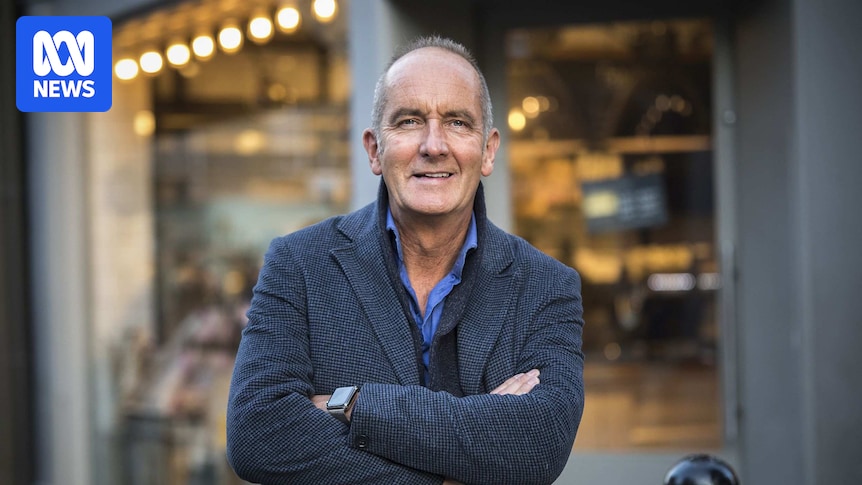
What makes a house a home? Kevin McCloud and Tim Ross might have the answer
Kevin McCloud knows clever design.
As the host of Grand Designs, he has spent more than two decades watching people build their dream home.
In that time, he’s seen blank slates transformed into lavish houses and given us a peek into the emotional ups and downs of building and renovating: from inspired architecture and joyful builds to expensive building mistakes and ambitious projects that almost always run over budget and/or time.
Now he’s about to embark on a tour of Australia with comedian, “great mate” and fellow design “nerd” Tim Ross, the host of ABC iview’s Designing a Legacy.
They sat down with the ABC to discuss good — and bad — design, and what makes a house a home.
‘We build what we want to be’
Ask McCloud which house style best suits his personality, and the answer might surprise you.
“In my head, my home is small. It is minimal, it is clean, and it is fabulous. It’s all the things I’m not,” he says.

Comedian and presenter Tim Ross has had a lifelong love for architecture and design. (Photographer: Caroline McCredie)
“We don’t just build who we are. We build what we want to be, so I’m going to take this opportunity to do something that is modest, super-efficient, green, small and beautiful.
“And it will only have one working toilet.” (We’ll come back to the issue of toilets later.)
Ross says he’s best suited to the modernist home he currently lives in, but concedes he’s probably more like a terrace house “that’s sometimes darker than I’d like it to be”.
“Is that too dark? Probably! Let’s go with the modernist house,” he says.
What would be its standout feature?
“They talk about how cats find the best places in a house. I’d like to think that my house would have plenty of places for cats to find the best place.
Kevin McCloud has been the host of Grand Designs for 25 years.
“Somewhere you can catch the northern sun on a winter’s day and fill your heart with the warmth. Simple things in houses are important.”
What does smart design look like?
Exceptional design can be found in the unlikeliest places and, according to McCloud, nothing beats the “simplicity and elegance” of a paperclip.
“One piece of wire — I love the beauty of that,” he says of the stationery staple first patented in 1901.
Ross nominates the Splayd, an all in-one knife, spoon and fork created by William McArthur in Sydney in the 1940s.
“It’s the perfect item for eating lasagne,” he says of the piece of cutlery that has had five million sales globally, according to the company website.
The Splayd was a popular inclusion on wedding registries. (Supplied: Karyn Unwin)
“Last night, I had a slice of pav on a plate while standing around talking to someone at a party … it’s the perfect, practical piece of design.”
Ross and McCloud also share an appreciation for magnets, Velcro catcher mitts and the ingenuity of the egg cracker, which McCloud says can turn a “miserable breakfast trying to deal with the egg and its shell into a beautiful time”.
“It makes this perfect circular crack at the top of the boiled egg”, he says of the German invention.
“It’s stuff like that we need more of.”
What makes a house a home?
When it comes to poor design choices, it’s the common idea that bigger is always better when building a home that frustrates McCloud.
“We’ve got to stop building big houses,” he says.
Are new homes too big? Kevin McCloud says they are and that it’s a problem. (ABC News: John Gunn)
“They’re hugely wasteful of materials — their carbon footprint is ridiculous — they cost a fortune to run, to heat and to cool, and to fill with furniture that we don’t want.”
He says space is not a “physical reality that you can measure with a ruler”, but a concept.
“It’s a view of the heavens. It’s that piece of glass in your ceiling above [the] shower, where you can look up and see the stars or the moon.
“Space is having that contact with the outside world, having that view through to something green, if you’re lucky, or even just people in the street [and your] neighbours.
“Having a building which puts you in contact with other people and allows communities to flourish, as opposed to isolating individuals.”
Captain Kelly’s Cottage on Bruny Island has a picture perfect view of its own private bay. (Supplied: Trevor Mein)
And the sudden proliferation of bathrooms and toilets in modern homes has not gone unnoticed by Ross, who doesn’t understand why people need “a million bathrooms”.
“Not every one of your kids needs an en suite,” he says.
“I think there’s something important about learning how to line up and wait to have a shower … for our emotional regulation.
“Most people seem to want to put in six or eight [toilets],” McCloud says. “Certainly, double the number of inhabitants in the building.”
As of 2024, the most desirable home in Australia according to Realestate.com.au is a house with four bedrooms and two bathrooms.
Perhaps not as many as double the occupants, but more than the standard Australian home built during the post-war period, when occupants were expected to share one bathroom and, if they were lucky, an extra toilet located outside.
‘The concerns of ghosts’
Australia is in the midst of a housing crisis, fuelled in part by a lack of affordable housing.
In 2024, it was estimated that 240,000 homes a year would need to be built to meet the National Housing Accord target of 1.2 million well-located homes by 2029.
But where exactly this housing will be built has become a sticking point. In Victoria, the state government’s plans for high-rise apartment developments centred around transport hubs across Melbourne’s suburbs have been met with resistance from some locals.
Are apartments the answer to Australia’s lack of affordable housing? (ABC: John Gunn)
“Quite often the reason we don’t go up is because of the grievances of people in their 70s and 80s,” says Ross.
“By the time the building’s finished, they like it and then they’re dead and so we’re living with the concerns of ghosts. And that’s problematic.
“That’s a very different situation from destroying heritage areas, which I simply don’t agree with.”
Imagination is key to conserving our heritage, and building places people want to live in, says McCloud.
“The difficulty with planning the built environment is it’s not a series of little components that you can tinker with.
“The best planning laws, design guides, local design guidance and neighbourhood plans, they all come about as a result of people getting together and being imaginative. Great architects, designers, planners…” he says.
Kevin McCloud and Tim Ross have a shared obsession for architecture and design. (Supplied: Modernister Films)
“Once you’ve enshrined it you can’t start picking [planning laws] apart because the whole thing crumbles from it, rather like an edifice.”
McCloud goes one step further and mentions English architect Nick Grimshaw’s “extreme but interesting idea” that we should stop demolishing buildings and instead adapt them.
“I gave a talk about heritage recently and I said we should stop knocking stuff down and we should think about creative reuse because of the carbon impact,” he said.
“I don’t want governments to pass a law saying we’re going to keep everything that’s a hundred years old.
“[I’m arguing for] proper, creative, holistic planning that covers not just the street, but wider areas … we need to put people at the heart of it.”
Kevin McCloud and Tim Ross will be touring their Live in Interesting Places tour around Australia in February.