
Donald Trump triggers a gold rush as investors flee the United States
What is that old line from the New York Yankees star Yogi Berra?
“It’s tough to make predictions, especially about the future.”
It has certainly been a tough time for financial forecasters this year, and we are less than a month into 2026.
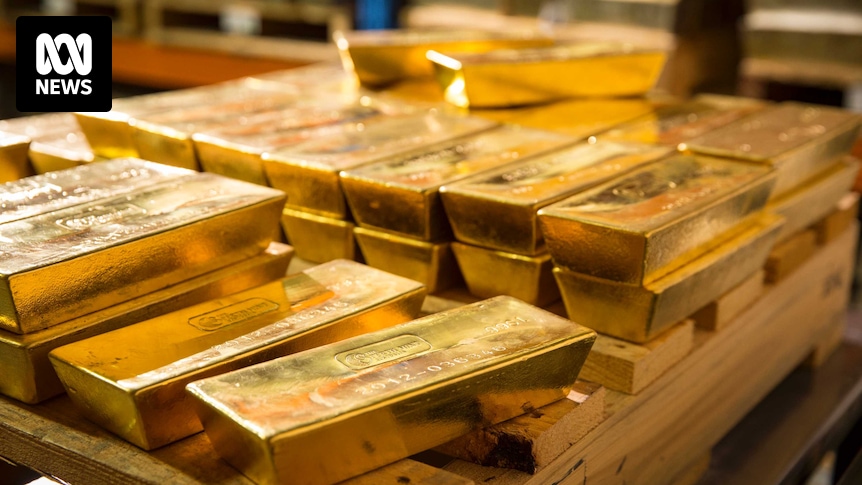
Gold prices, we were told late last year, could rise as high as $US5,000 ($7,222) an ounce before the year was out.
Even after the torrid pace of price gains throughout 2025, it seemed a brave call. But the barrier was breached within three weeks.
Silver has been on even more of a tear, particularly in the past few weeks. Its price has quadrupled over the course of the past year, with many concerned that a speculative bubble is forming in commodities traditionally viewed as a store of wealth and prized for the lack of volatility.
While the surging gold price has been a surprise, the driving forces behind it are not.
Investors are losing faith in the United States and its role as the standard-bearer for global capitalism.
“The global order is shifting and trust is gone,” Swissquote senior analyst Ipek Ozkardeskaya says.
“Restoring it will take time.”
US President Donald Trump’s rambling and meandering speech to the World Economic Forum in Davos last week, threatening an escalation in his trade war and the use of military force against America’s NATO allies, marked a turning point.
Even after the president walked back the threats, the damage had been done.

Donald Trump told the World Economic Forum at Davos Greenland was “in a key strategic location between the United States, Russia and China”. (Reuters: Denis Balibouse)
US dollar under pressure amid Davos fallout
The fallout from Davos has been spectacular.
The US dollar has dropped more than 2 per cent, sending the Australian dollar soaring, while interest rates on US money markets remain elevated as cash flows out of the US.
While the turmoil has been in full swing since April 2 last year, when Mr Trump unveiled his “Liberation Day” tariffs, the search for new safe havens began almost a decade ago.
That is when China began selling down its holdings in US government debt — essentially IOUs — which had long been considered the safest place to park your cash.
China’s huge trade surpluses were mostly invested in US debt, elevating it into America’s global bank.
But by 2017, as concerns mounted about its relationship with the US, it began offloading those IOUs and diversifying its foreign holdings, primarily focusing on gold. Russia had also been loading up on gold and then India followed suit.
Central banks globally then began diversifying away from US dollar-denominated debt and into gold. While that created solid demand for the precious metal, prices remained relatively stable.
Prices began trending higher as the US election campaign moved into full swing during 2024 as investment funds and, more recently, retail investors piled into gold.
That trend has gone into overdrive as Mr Trump’s constant trade threats, the capture of Venezuelan President Nicolas Maduro and the highly personal attacks against US Federal Reserve chairman Jerome Powell have rattled investors.
Escalating that into a threat to forcefully take control of a NATO territory added a new dimension to the uncertainty.
Debt and deficits add to precious metals’ lustre
Where will it all end?
That is the $US38 trillion — the level at which US government debt now stands — question.
RBC Capital Markets commodity strategist Christopher Louney expects the price gains to continue.
“Uncertainty and macro, especially dollar weakness, have driven the gold-positive backdrop year-to-date, and in many ways, a lot of the key drivers for gold from last year exist in some capacity — especially uncertainty,” he says.
“Between trade, politics, geopolitical instability, Fed independence concerns, there are plenty of drivers to look at.
“Likewise, based on all our conversations in the first few weeks of the year, we do not think investor or central bank demand will fall away.”
That search for safety has focused on hard assets. Paper, especially promises to repay debt from increasingly cash-stretched borrowers like the US and Japan, no longer holds the appeal for investors that it once did.
Metals, particularly anything to do with the roll out of renewables, such as copper or lithium, have been in hot demand.
And then there is silver. While it has widespread industrial uses, particularly in terms of energy, industrial demand alone cannot explain the galloping price.
As a policy, “America First” appears to be having the opposite effect. Global investors are putting the US way down the priority list.
Mr Trump promised Americans a new golden age. Nobody envisaged it would quite work out like this.