
Farmers warn of food price spikes within weeks as Middle East war continues
Australia’s peak farming body is warning consumers the price of groceries is about to jump as producers and the freight industry grapple with diesel price hikes and supply issues.
Since the US-Israel war on Iran broke out last month, diesel prices have surged in Australia and demand in some regional and rural areas has doubled, according to the prime minister.
National Farmer’s Federation (NFF) president Hamish McIntyre said many farmers across the country were still facing difficulties getting fuel onto farms, and transport businesses tasked with moving goods to cities and ports are struggling to absorb rising costs.
That is despite the federal government taking actions including tapping into its emergency fuel supplies.
“We estimate in a matter of weeks we’ll start to see the costs flow through to the consumers on supermarket shelves,” Mr McIntyre said.
The NFF president, who runs a mixed-farming business in Queensland, anticipated shoppers will see the cost of dairy go up first.
“It starts with dairy, then our fruit and veg, and in any of our intensive animal industries too,”
he said.
While the NFF is yet to land on what specific measures it would like the government to take to help impacted farmers, Mr McIntyre has urged Australians to work together and not panic-buy diesel.
“Diesel drives food production across Australia so it’s around the diesel space that we really need to make sure that is available for our essential services, number one, but then our farmers and food producers after that,” he said.
Transport bodies sound alarm
The NFF’s prediction of an imminent food price hike in the supermarkets has been echoed by the National Road Transport Association.
Chief executive Warren Clark said the nation was heading in the direction of a “broken freight supply chain”.
“Come the 21st of April [2026] when a lot of the fuel bills start to come in, and the fuel price will have increased steadily to then, we’re going to see some major changes in this freight industry,” he told ABC’s Radio National.
Mr Clark explained that small to medium businesses may not be able to pay their fuel bills and warned that the impact will flow to consumers.
“You could see [food] prices increase dramatically,” he said.
“It’s the only way that people can grasp how bad this situation is — when they go down to their supermarkets and shops the stuff’s just not there to buy.“
The National Road Transport Association has called for urgent help from the government, chiefly suspending the road user charge to help increase cash flow for trucking businesses.

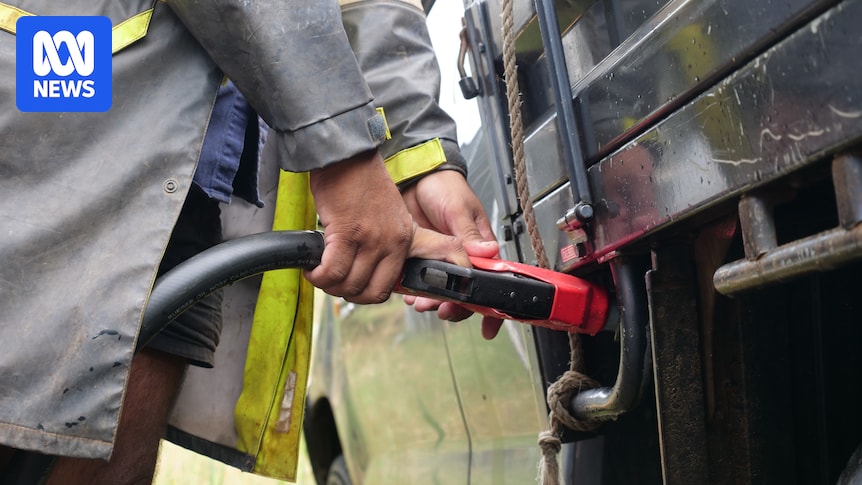
There are warnings that businesses may not be able to pay their fuel bills. (ABC North Qld: Meghan Dansie)
The Transport Workers’ Union, trucking employers and industry groups have also urged the government to amend the Fair Work Act to enable emergency powers to deal with surging fuel prices.
TWU national secretary Michael Kaine said drivers and businesses cannot wait “even weeks” for action.
“Businesses are at imminent risk of collapse and workers are under deadly pressure because there are huge retailers and other clients out there refusing to pay their fair share for skyrocketing fuel costs,” he said.
National food supply chain assessment announced
A new assessment for Australia’s food supply chain was commissioned by the federal government on Monday, with the nation’s diesel supply the first focus.
Minister for Agriculture Julie Collins announced the measure at the National Food Council meeting in Canberra, which saw government and industry experts gather to discuss the ongoing impacts of the Middle East war on the nation’s food system.
“This assessment will provide advice to government on ways we can continue to strengthen preparedness for disruptions to food production and supply chains,” Ms Collins said in a statement.
Loading
The assessment will be led by Andrew Henderson from AgriFutures, a government-established body, and initially focus on diesel supply chains.
An interim report will be provided to Ms Collins within a month, with a final report due by the end of the year.
Loading…