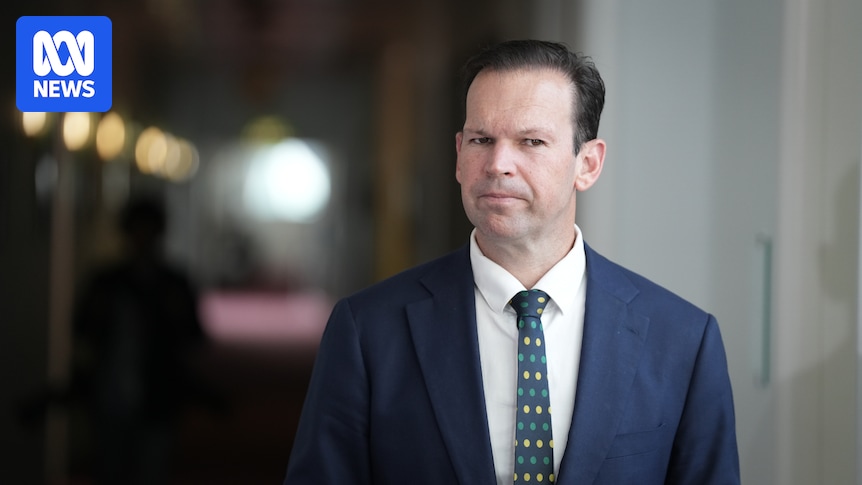
Matt Canavan’s rebrand takes shape in sunglasses, Albanese rebukes Trump

Welcome back to your weekly federal politics update, where Courtney Gould gets you up to speed on the happenings from Parliament House.
A week after Matt Canavan was elected the new Nationals leader, he changed his Facebook profile picture.
Gone was the four-year-old image of him, hand on hip, addressing a rally for a local ring road, replaced by Canavan smiling away wearing a pair of Pit Viper sunglasses at the local version of the Conservative Political Action Conference (CPAC). It’s a classic throwback to 90s Aussie bloke core.
Canavan himself acknowledged the throwback as he put on the “retro” specs gifted by his kids.
He wasn’t keen on returning Australia back to the 1950s, he said, but maybe a look at how things were in the 1990s wouldn’t be too bad.
In the six months since, Canavan has racked up a number of wins. The Coalition dropped net zero, the Nationals caused Coalition chaos by not supporting the government’s hate speech laws, and he traded the backbench for the leadership.
“You wouldn’t have given me a chance in hell to convince people on net zero. You were all dismissing me. I was a crank … and now not only is the Liberal Party not supporting net zero, the prime minister won’t even mention the words,” he said at his National Press Club address on Wednesday.
Like his address to CPAC six months ago, Canavan continued his crusade against the net zero climate target. But he’s rebranded to calling his vision “hyper Australia” (that name being another gift from one of his sons) or “Australia on steroids”.
His answer for making Australia more affordable is not by looking back but by adopting a “pioneer spirit”. He wants to drill for more oil and gas and more stuff made here — including more babies — and for tariffs to be used. A look to the stars wouldn’t go astray either.
Canavan’s first leadership test is looming
All in all, Canavan’s speech didn’t stray far from the conservative populist mould.
Elements of his speech (such as tariffs) echo US President Donald Trump’s agenda. But much like attendees at the CPAC conference in Dallas that took place at the end of March, Canavan echoed the split within Trump’s own base over the war. He went as far to describe Trump’s rhetoric on Iran as going “way too far and beyond the realms of acceptability”.
Canavan was elected at a time of a surging One Nation. His first test is only weeks away in the Farrer by-election where Pauline Hanson’s party could outpoll both her Coalition counterparts.
His economic views put him at odds with Angus Taylor (not that the opposition leader will say that publicly). By breaking ranks, it puts him more in line with M-O of Andrew Hastie. Hastie was given a talking-to by Taylor after breaking ranks with the rest of his colleagues during an Insiders interview two weeks ago.
Both men are talking to voters in the same way. It’s direct and to the point and mostly cuts out the pollie-waffle that Taylor and Anthony Albanese are known for. They wouldn’t like the comparison but it’s almost reminiscent of Dan Andrews.
On the other side of the populist coin was the re-emergence of Max Chandler-Mather this week. The former Greens MP has kept a relatively low profile since he was ousted from his Brisbane seat of Griffith at the last election.
He’s re-launching the Greens Institute, the minor party’s answer to Labor’s Chifley Research Centre or the Liberal-aligned Menzies Research Centre, with a focus towards policy development.
In interviews with Chandler-Mather about the job he made reference to adopting the approach of New York mayor Zohran Mamdani.
Loading
Albanese sharpens his reaction to Trump
A rise in the cost-of-living has voters understandably grumpy. The Iran war and the subsequent fuel crisis is only making that worse. The government is not unalive to it.
Albanese brought forward his planned trip to Singapore as he launched another round of his charm offensive in Asia. Singapore is one of Australia’s biggest suppliers of petrol and the government is hoping to leverage our LNG exports that the island nation needs to keep supplies flowing.
Before he headed off the government inked a deal with Australia’s two refiners, Ampol and Viva, to help them buy extra shipments of oil on the spot market.
It did so by using the powers it rushed through during the last sitting of parliament to guarantee any losses the companies would make. At what cost? The government won’t tell us.
Understandably, the government is not keen to make any predictions about where things will go now, and if the ceasefire can hold. But it has indicated the budget will be finalised later than usual as a result of the current tensions.
Much like its soft launching of areas it wants to target in the budget (think the capital gains tax discount or finding ways to cut the growth rate in the National Disability Insurance Scheme) the government’s language towards Trump is also starting to shift.
For months now it’s avoided getting dragged down into a daily commentary on whatever Trump has said on social media about Iran. The issue of the legality of the initial strikes (which the government supported) also wasn’t a question for Labor but for the US.
But as the war continued Albanese dipped his toe by calling for Trump to outline clear objectives moving forward. By midday Wednesday, Albanese was prepared to say Trump’s threat to wipe out a “whole civilisation” was both “inappropriate” and “extraordinary”.
As David Speers wrote, it was a “rare prime ministerial rebuke of a president’s wartime positioning”.
The government knows the current voter sentiment is against Trump and is keen to remind people that any hip pocket pain is not because of Labor.
“These were decisions taken around the table of the Situation Room in Washington DC but Australians are assembled around their kitchen tables working out how to pay for it,” Treasurer Jim Chalmer said today.
Labor may have that cover for now. But if one lesson from the pandemic is to be learned, voter sentiment can shift. Quickly.
Perhaps that’s why Albanese was is off to Singapore. Or why the deal was signed with Viva and Ampol to “buy fuel for Australians that otherwise would go to other countries”.
The government doesn’t want to repeat the mistakes of the past where Australia wasn’t at the front of the queue for the COVID vaccines or rapid antigen tests.