
Inside Australia’s push to build a sovereign missile industry
Australia is stepping into a new phase of its military evolution, producing a type of high-precision, sniper-like missile on home soil for the first time.
Along with the United States, it is now one of the only nations manufacturing these guided weapons.
The move comes amid a global surge in arms production not seen since World War Two, signalling a more competitive security landscape.
Rising tensions from the Middle East to East Asia are driving nations to invest heavily in advanced military technology, and Australia is now positioning itself within that shift.
At the heart of this move is a broader strategy: to strengthen national defence and prepare for a future in which conflicts may edge closer to Australian shores.
Defence Industry Minister Pat Conroy describes the moment as the largest arms buildup in the region since 1945, arguing that extending the strike range of the Australian Defence Forces (ADF) is no longer optional, but essential.
“This is all about supporting peace by deterring war,” he tells SBS News.
And one of the best ways of doing that is letting any potential adversary know that you can strike back and hit them where they’re vulnerable.
The government’s goal is to establish a sovereign missile industry covering the full spectrum, from mining raw materials to manufacturing and deployment.
It also sees an opportunity to deepen strategic ties by exporting these weapons to “like-minded allies”.
But the ambition comes with challenges. Experts warn that creating a fully independent supply chain is extremely complex, if not “near impossible” — requiring years of investment and technical expertise.
The effort also raises broader questions about how far Australia can, or should, reduce its reliance on allies while strengthening its own resilience.
How Australia is boosting its defence capabilities
As part of its domestic missile program, Australia is now producing guided multiple launch rocket systems (GMLRS) — a type of precision missile — which will enhance the ADF’s strike capabilities.
The GMLRS serve as the primary weapon for the High Mobility Artillery Rocket System, with a range of 70km.
Conroy says the first batch of these precision rockets was manufactured in March.
“We have begun manufacturing missiles in this country — the first time that’s occurred in 50 or 60 years — and our plan is to have three missile factories up and running,” he says.
The Department of Defence has said it plans to establish a high-rate manufacturing facility capable of producing 4,000 missiles per year by 2029, supporting both domestic and export requirements.
The department emphasises that GMLRS differ from standard rockets.
“They feature guidance kits and control systems for course correction and precision fires at range,” the department said in a statement to SBS News.
“Plans are to eventually manufacture the Precision Strike Missile, a more advanced weapon with future increments capable of striking targets over 1,000km away.”
Oleksandra Molloy, a senior lecturer in aviation safety at the University of New South Wales, explains what sets GMLRS apart from other weapons.
“While other missiles can be fired in large volumes to saturate an area, this one is particularly a 70km sniper because it has precision, it can strike high-value targets, and reduce the number of rockets used at a time, so minimising collateral damage,” she tells SBS News.
“Having said that, the range of 70km seems a little bit limited if we think about the vast area that could be needed in the Asia Pacific.”
Despite this, Molloy notes that while the GMLRS lack long-range capability, they can be used defensively to “great effect”, such as intercepting long-range drones.
She says domestic production becomes critical in a conflict scenario where supply lines are under pressure.
“If we think about sovereignty in any major potential conflict, global shipping lanes can be cut off. And if Australia can’t build its own ammunition, it’s out of the fight in weeks.”
How are missiles made?
Missiles, like other advanced weapons and military apparatus, rely on a complex mix of raw materials, specialised components and highly technical manufacturing processes.
Australia holds some of the world’s richest reserves of naturally occurring minerals required to make missiles, while relying on imports for other key ingredients.
The structure is made of materials such as titanium, aluminium, and heat-resistant composites.
Internally, they contain sophisticated electronics, guidance systems and the explosive warhead itself.
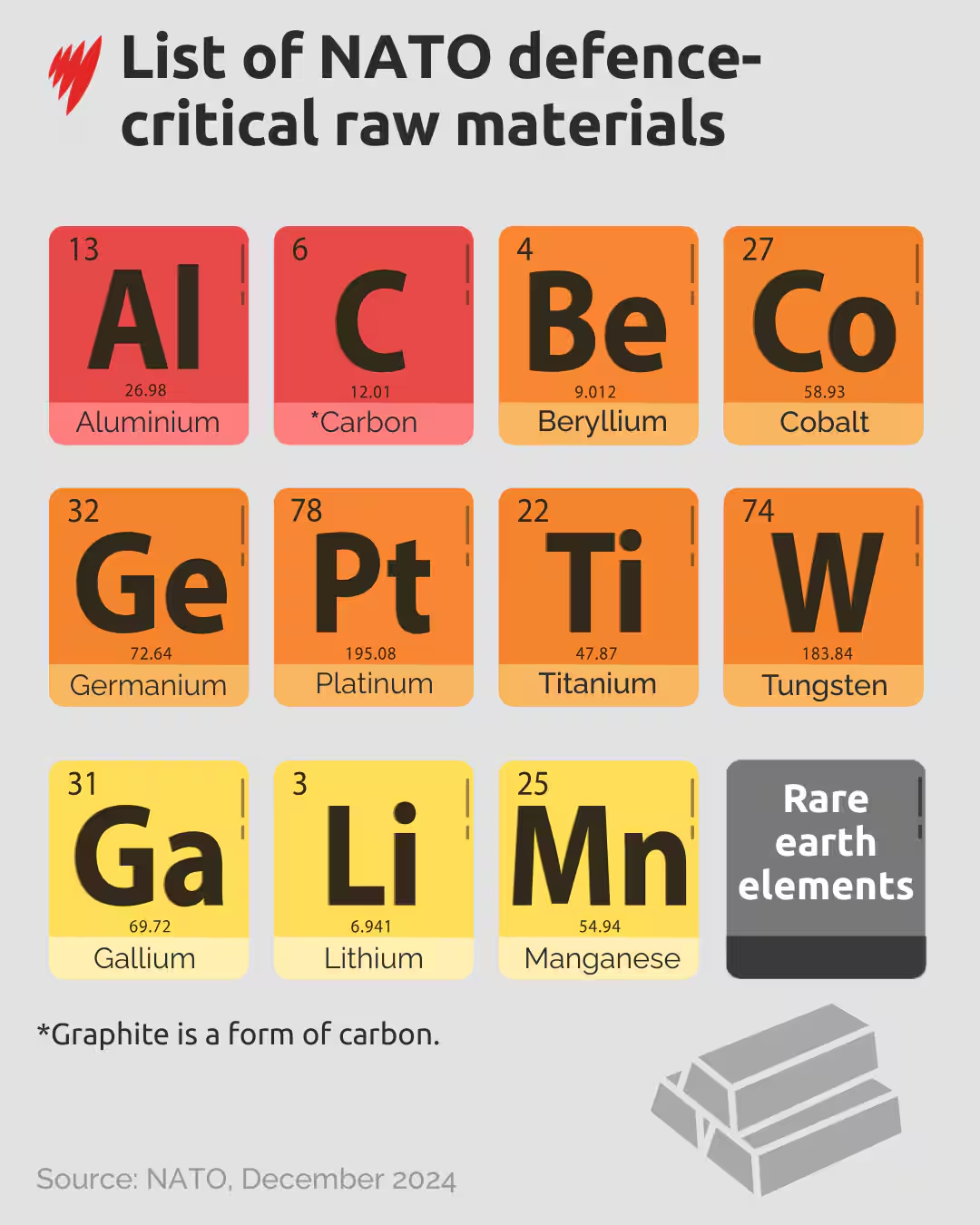
NATO estimates that 20 raw materials are used in the manufacturing of missiles.
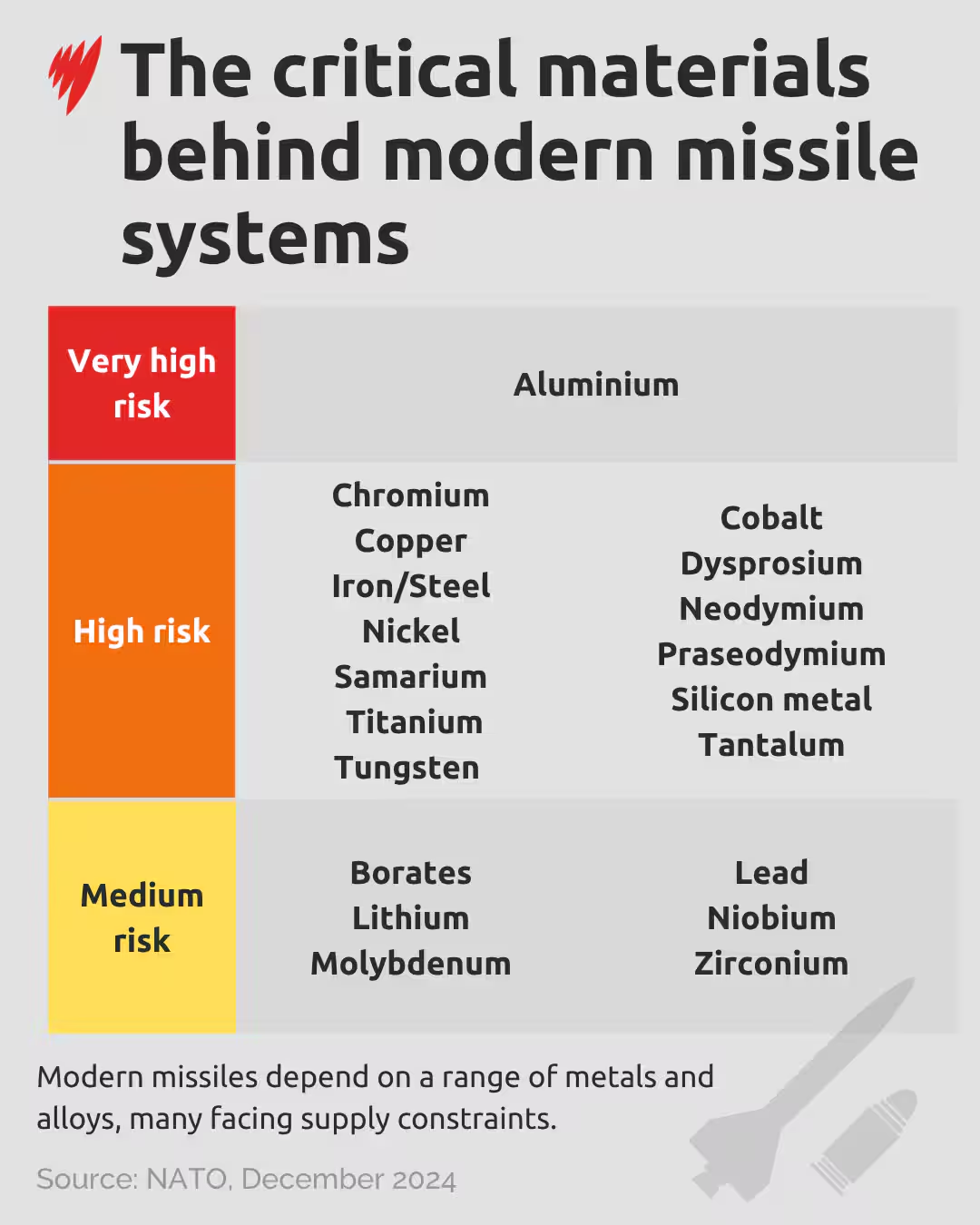
Securing access to these materials has become a strategic priority.
In October 2025, Prime Minister Anthony Albanese signed a deal on rare-earth minerals in Washington aimed at strengthening supply chains for defence and advanced technologies.
The agreement includes joint investments between Australia and the US in rare earths, US funding for processing critical minerals, and planned projects involving the US, Australia and Japan.
This move forms part of a broader shift by Western countries seeking to disrupt China’s dominance of the global supply chain — accounting for around 70 per cent of global mining and 90 per cent of global processing, according to the International Energy Agency.
The missile supply chain
While Australia is resource-rich, building a fully independent missile supply chain presents significant challenges.
Vlado Vivoda, an expert in critical minerals from the University of Queensland, says achieving this is “near impossible”.
The missile production process is typically divided into three stages: upstream (sourcing raw resources), midstream (processing the resources), and downstream (manufacturing the final product).
While we have raw minerals and materials, we are quite weak in advanced material manufacturing.
“So we don’t make magnets, alloys, or chemicals for these weapons. We don’t do components, we don’t make chips here, sensors, those kinds of electronics, and the subsystems as well that go into missiles, like guidance, propulsion, warheads, and so on,” Vivoda tells SBS News.
This leaves Australia reliant on allies like the US for these sophisticated components, even as it continues to export raw materials and make domestic upgrades.
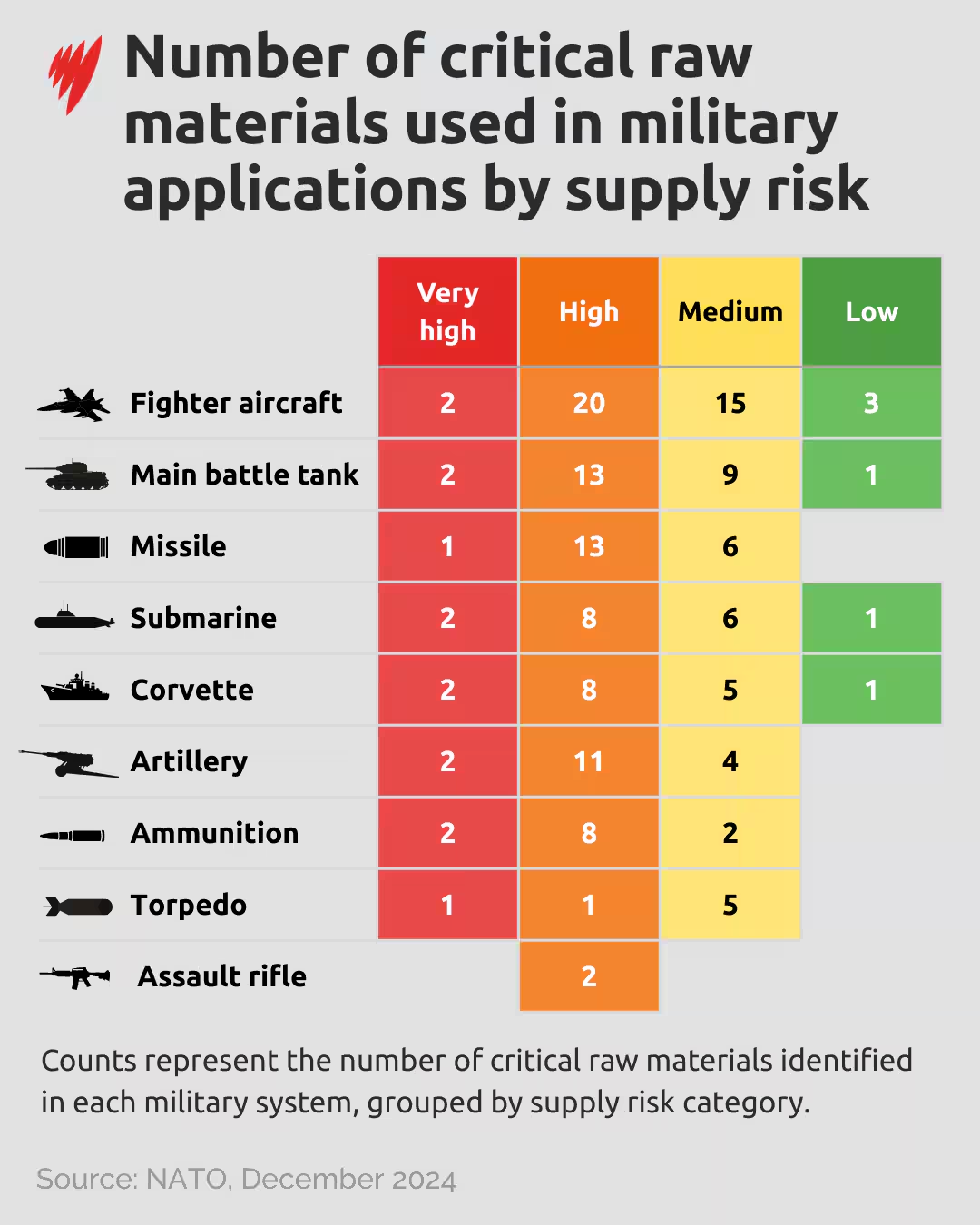
“We’re pretty well endowed in terms of upstream position for a lot of these minerals that we produce. From lithium that goes into batteries and guidance systems to nickel, cobalt, and manganese that usually go into alloys and batteries,” Vivoda says.
Australia also produces other key materials, such as titanium, zirconium, tungsten and graphite, he says.
However, Australia is particularly weak in the midstream stage of the supply chain.
“What I think tends to happen is we export the raw material here, it’s processed overseas, and then we bring it back, along with other components for manufacturing onshore,” he says.
Despite these challenges, Australia’s strong upstream position places it in a favourable economic position, he says, giving the government scope to enhance both processing and manufacturing capabilities.
Vivoda points to large investments in mining infrastructure and lithium hydroxide plants as evidence of the defence industry’s ambitions to boost the production of Australian-made missiles.
In the future, with a lot more investment, I can see a sovereign physical backbone being realistic, but I wouldn’t say full sovereignty is in the future.
“For a country of some 27 million to be able to create weapons entirely independent of other countries is possible, but I think we would need to be fully mobilising for war at the expense of other sectors.”
Missile industry blasting off
While Australia accelerates its domestic missile production, countries around the world are ramping up defence spending.
According to the Lowy Institute, the US led global defence spending at US$1.03 trillion ($1.49 trillion) in 2025, followed by China at US$374 billion ($542.5 billion), and Russia at US$271 billion ($393.1 billion).
Australia’s defence budget was far lower at US$38.8 billion ($56.28 billion) last year.
Many countries are spending more on defence than in previous years.
David Andrews, a senior policy adviser at the Australian National University’s National Security College, says this points to growing recognition of global instability.
“Countries are realising that maybe the world is a slightly more dangerous place than they anticipated a few years earlier,” he tells SBS News.
“There’s a concern that we’ll see even more conflicts not just in Europe and the Middle East, but possibly in the Pacific, closer to home for Australia as well.
“So, there’s a great desire in defence as well as in the broader international defence community to equip modern militaries as quickly as possible, for fighting high-intensity conflicts.”
But some analysts caution that rising defence spending and expanded weapons production can also carry risks, potentially fuelling regional arms competition rather than simply deterring conflict.
They warn that ‘action-reaction’ dynamics can drive arms racing, even if no side actually wants conflict, according to analysis by the Stockholm International Peace Research Institute (SIPRI).
Even so, modern conflicts are using “staggering” amounts of munitions, creating supply shortfalls that countries are racing to address. This growing demand is opening up opportunities for Australia to step in — both as a producer and a potential exporter.
Conroy says exporting missiles is a way Australia can generate revenue to reinvest in its defence industries and the economy more broadly.
“You just have to learn the lessons from Ukraine to understand how stretched global demand is for munitions as people invest in their capabilities to deal with an uncertain world,” he says.
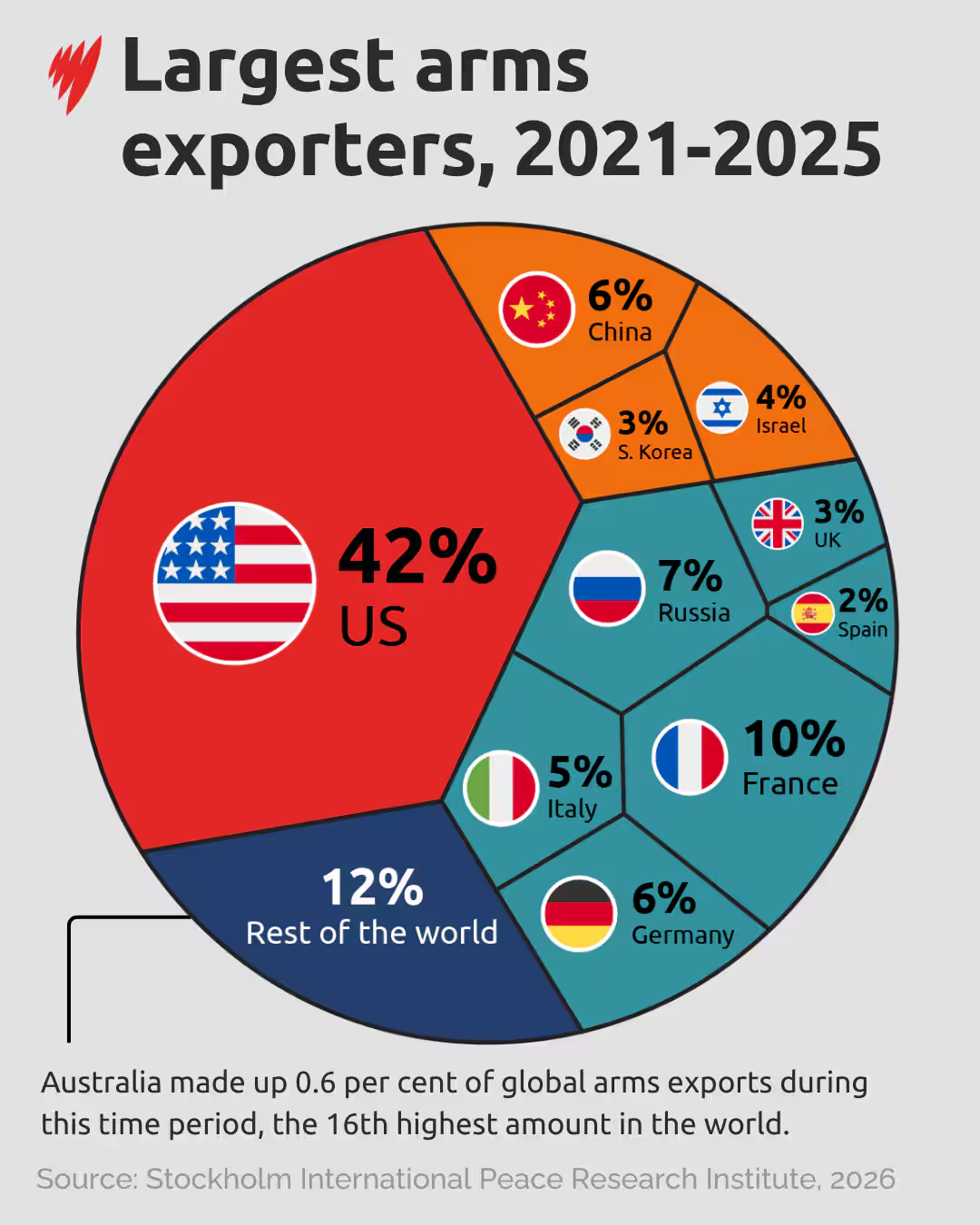
Australia made up around 0.6 per cent of global arms exports between 2019 and 2023, according to SIPRI.
Over that same period, the US accounted for 42 per cent of global arms exports, followed by France at 10 per cent and Russia at 7 per cent.
Ethical debate over missile exports
Australia’s expanding role in defence exports has raised both strategic and ethical questions — particularly around how military-related items supplied overseas might be used.
Australia is part of a group of US-led F-35 partner countries that supply components to a global supply chain, which Israel uses to maintain its F-35 fleet.
In July 2025, Foreign Minister Penny Wong was asked about reports that Australia had exported parts for F-35 jets to Israel. She said the government only exports “non-lethal parts” for the jets and reiterated that Australia has not supplied weapons or ammunition to Israel since the conflict in Gaza escalated in 2023.
John Coyne, director of the Australian Strategic Policy Institute’s national security program, says Australia has a long history and a complex body of law and regulatory framework for arms trading, which would apply to the missiles themselves and the individual components.
“Australia has those protections in place, it uses those protections, and it holds companies to account for those protections on a regular basis,” he says.
Critics, including human rights organisations and some politicians, argue that even non-lethal components can contribute indirectly to lethal systems, and that greater transparency is needed to ensure exports comply with international humanitarian norms.
Amnesty International has previously warned that components supplied into global supply chains can still be linked to end-use in active conflicts, often resulting in serious violations of international human rights and humanitarian law.
The debate highlights Australia’s challenge in balancing strategic alliances, industrial growth and legal obligations, while ensuring transparency and accountability in defence exports.
What will happen to Australia’s missiles?
Meanwhile, Australia is moving ahead with plans to produce missiles domestically.
Conroy says the new Australian-made missiles will serve dual purposes: supporting domestic defence and supplying allied partners.
“We want the scale and the opportunities to supply allies and like-minded partners because there’s a huge backlog of that missile around the world,” he says.
When asked which countries will receive these missiles, Conroy says the GMLRS would likely be exported to the US, Europe and Japan.
“However, no decisions have been made at the moment, but there are strict export regimes that guide where these go and obviously, the strict laws that we follow at all times,” he says.
Andrews describes this strategy as a “collective alliance”, noting that threats Japan and the US may face — particularly from China — could also affect Australia.
“So, pursuing export opportunities for that, I think, is a really positive thing,” he says.
Coyne says the sale and stockpiling of GMLRS are part of a broader defence strategy to build Australia’s domestic missile industry.
He explains that starting with simpler missiles that can be exported generates revenue and experience, forming the foundation for producing more complex systems in the future.
“You’ve got to start somewhere in terms of rejuvenating and creating that type of defence industry.
“It’s a crawl before you walk and before you run approach.”
For the latest from SBS News, download our app and subscribe to our newsletter.