Trump’s Iran response puts FIFA World Cup 2026 in ‘uncharted territory’
In brief
- The war in the Middle East is threatening to upend the World Cup which kicks off in two months.
- Iran is increasingly looking like it will pull out, posing both a logistical and geopolitical problem for FIFA.
With the war in the Middle East continuing to impact global travel and diplomacy, the conflict is also casting uncertainty over the upcoming FIFA World Cup being held in the US, Canada and Mexico.
After talks between the United States and Iran failed to result in a peace deal, the conflict shows little sign of ending. Iran is now looking increasingly unlikely to take part in the tournament, which kicks off in less than two months.
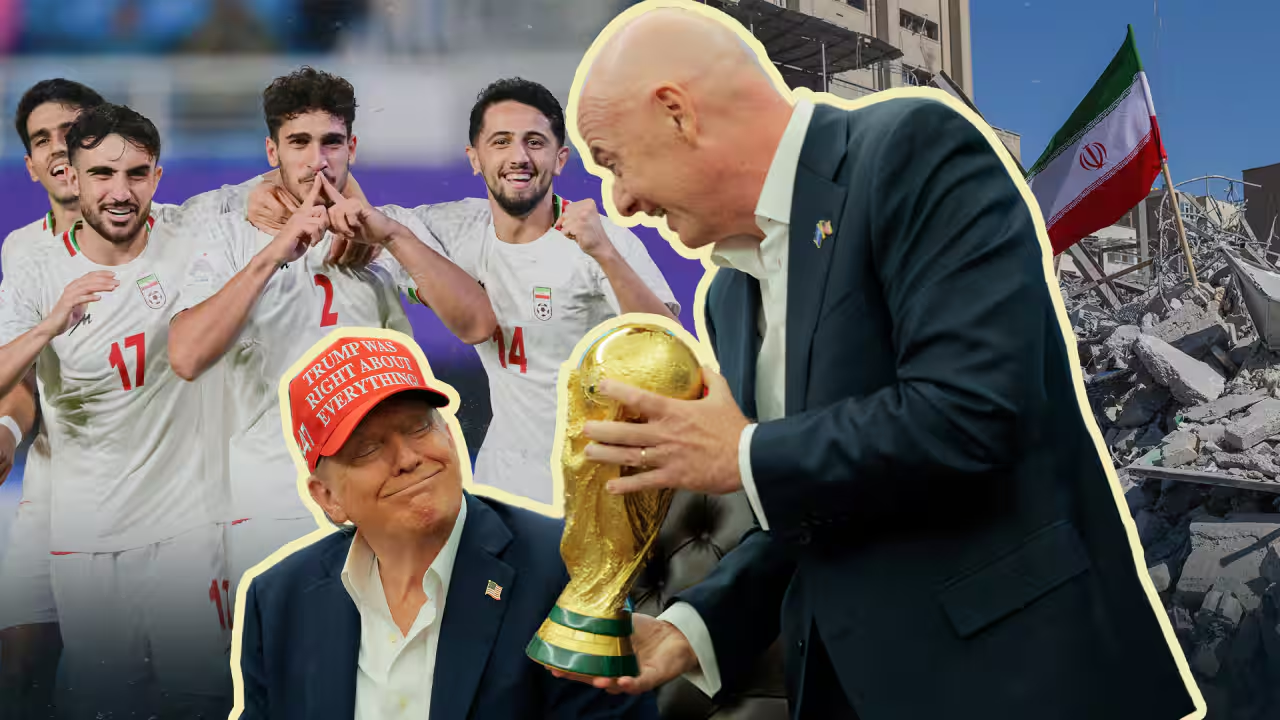
That poses a geopolitical challenge for FIFA, which must convince Iran to play on US soil despite comments from US President Donald Trump that it would not be “appropriate” for the team to attend “for their own life and safety”.
If the war continues and Iran does play, it will make it the first time in World Cup history that a country has participated in a tournament while it is at war with one of the host countries.
If Iran withdraws, FIFA would face an immediate logistical challenge — filling a gap in the schedule so close to kickoff.
Some teams have had preparations scuppered and matches cancelled as travel to the Middle East remains heavily disrupted.
There is little precedent for such a move — the closest parallel came in 1992, when Yugoslavia was kicked out of the European Championship just 10 days before it started due to civil war.
They were replaced by Denmark, the runners-up in Yugoslavia’s qualifying group, who went on to win the tournament.
What happens to the World Cup schedule if Iran does withdraw?
Last month, Iran’s sports minister Ahmad Donyamali said “under no circumstances” could the men’s national team play in the World Cup.
The country’s football body, the Football Federation of the Islamic Republic of Iran, had raised concerns about player safety after Trump said the team was “welcome” to play, but he didn’t believe it was “appropriate that they be there, for their own life and safety”.
Iran has requested its group stage matches — scheduled to be played in the US — be moved to Mexico, which is co-hosting the event with the US and Canada.
Mexico was open to the move, but FIFA has so far refused, with Mexican President Claudia Sheinbaum last week confirming organisers thought relocating Iran’s matches “would make logistics too complicated”.
FIFA president Gianni Infantino has insisted Iran will play.
“We want them to play; they are going to play in the World Cup. There are no Plans B or C or D; Plan A is the only plan,” he said in early April.
Iran are continuing their preparations, with the team training in Türkiye.
“We will prepare for the World Cup. We will boycott the United States but not the World Cup,” Iranian Football Federation head Mehdi Taj said last month.
If Iran does pull out, FIFA’s own regulations state it has “sole discretion” to “take whatever action is deemed necessary”. That could open the door for another nation to play at short notice.
Sports news site The Athletic has suggested the United Arab Emirates could be next in line as the highest-ranked Asian team not to qualify. Italy has also been floated as a potential replacement.
ESPN, citing unnamed FIFA sources, reported FIFA would continue to monitor the situation and was unlikely to make any final decision until the FIFA Congress, where final preparations are, on 30 April in Vancouver.
Dr Steve Georgakis, a sports studies expert at the University of Sydney, said the fact Iran has a strong squad could also influence its decision. The team are currently ranked 21st globally according to FIFA.
“From a nationalistic point of view, that’s something that will motivate them to perhaps stay in the World Cup,” he told SBS News.
If Iran does pull out, it could face disciplinary sanctions by FIFA, including bans from future tournaments and fines.
According to the 2026 FIFA World Cup regulations, any team that withdraws faces financial penalties of between $448,000 and $897,000, depending on the date of withdrawal.
FIFA’s diplomatic tightrope
The war presents not just a logistical challenge but a geopolitical test for FIFA, which must balance its claim of political neutrality with mounting pressure.
Tom Heenan, who teaches sports studies at Monash University, told SBS News he believed Infantino would lean on his close relationship with Trump to resolve the issue.
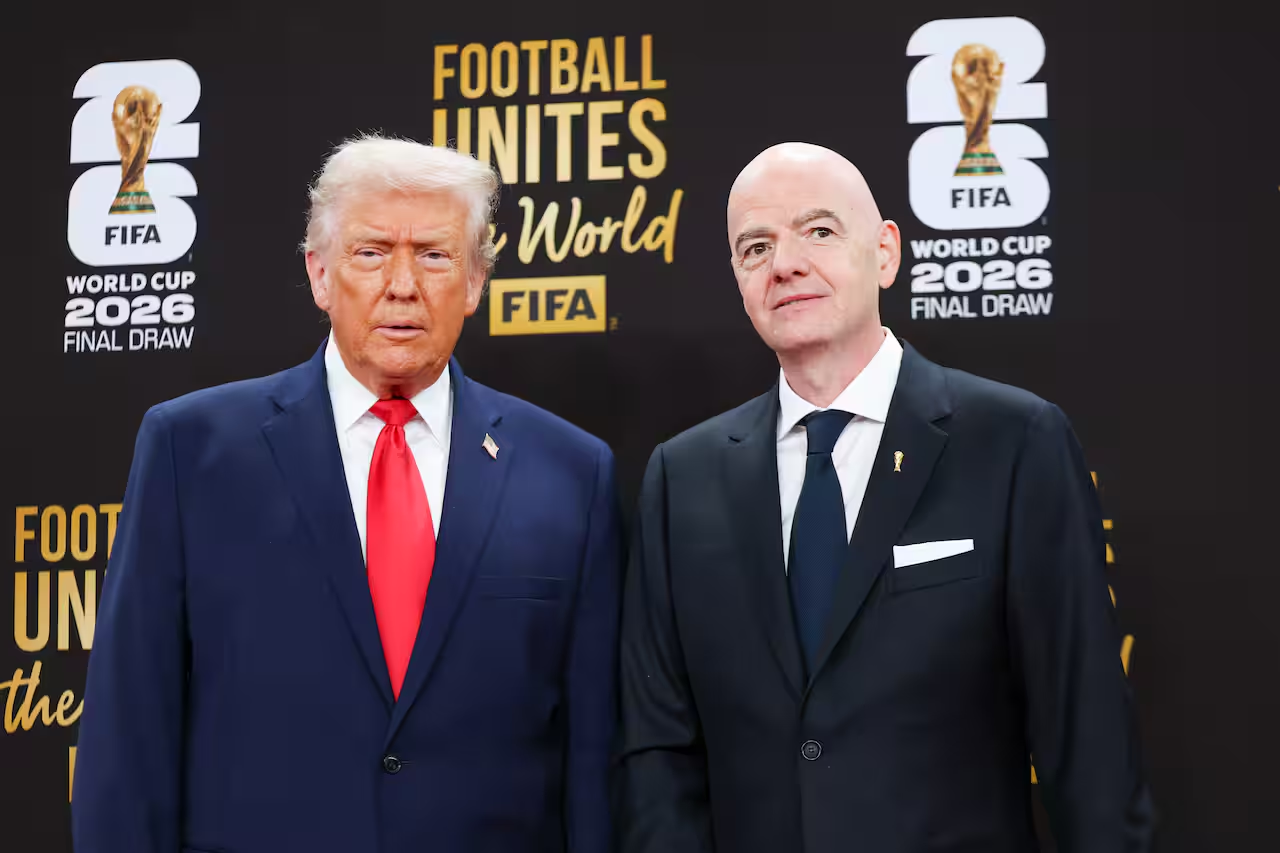
“I suspect FIFA has no fallback plan, and I suspect also that Infantino has a very high opinion of his diplomatic skills,” Heenan said.
Infantino has drawn criticism for his ties to Trump, notably when he awarded the US president the inaugural FIFA Peace Prize in December last year.
Heenan said Iran may use the tournament as a chance to defy the US on the world stage.
“[If Iran withdraws] it loses an opportunity to play a very free diplomatic game, a game on a sporting field in which it says ‘We will not bow down’,” he said.
Iran could also use the World Cup as an opportunity to challenge perceptions of the country, in light of Trump’s “unreasonable” demands.
In recent weeks, the US president has made several inflammatory statements, including that Iran’s “civilisation will die” unless it agrees to a peace deal and the unblocking of the Strait of Hormuz.
Critics say the war in the Middle East and FIFA’s response to it raise questions about the association’s supposed commitment to political neutrality.
Russia was banned from all FIFA and UEFA football competitions following its full-scale invasion of Ukraine in 2022, but Israel and the US have not faced any sanctions for launching strikes against Iran.
Dr Stuart Murray, an international relations and sports diplomacy expert at Bond University, said that major sporting events reflected global events and that the conflict would heighten the terrorism risk.
FIFA was in “uncharted territory” as it tried to navigate US and Iran tensions, he added.
“I think the tragedy is here we were looking forward to a really positive sporting event, and it’s been blighted [by the war in the Middle East],” he said.
Security concerns and travel bans
The conflict also raises security concerns for the US, which will be on heightened alert as millions of international visitors flock to the country for the World Cup.
However, Iranian fans won’t be able to travel to the US for the tournament. It is one of 19 countries that fall under Trump’s second travel ban, introduced last year. Players, coaches and some support staff will be exempt.
Georgakis said he expected all three host countries to make security an “absolute priority”.
“The security precautions are going to be at a level that we’ve never seen before in a World Cup,” he said.
Andrew Giuliani, the executive director for the White House World Cup task force, said last year more than US$1 billion ($1.4 billion) would be spent on security, including law enforcement, cyber-security and “counter-unmanned aircraft systems” to combat unlawful drones.
Extra measures had also been taken to make the border system “secure, accountable, efficient, and fully prepared”.
“Our message is simple: We can secure our borders while opening our doors to the world,” Giuliani said.
For the latest from SBS News, download our app and subscribe to our newsletter.