Australia’s student visa crackdown hits record highs — what it means for who gets in
“I thought I had submitted a strong visa application,” says Pavan Kumar, a 23-year-old engineering graduate from Hyderabad in southern India who had secured admission to study information technology at Deakin University in Melbourne.
He had paid his initial tuition deposit, organised the funding, and met the English language requirements. On paper, his pathway to Australia looked straightforward.
A few days later, his student visa was refused.
The decision, issued by the Department of Home Affairs, cited concerns about whether he met the ‘genuine temporary entrant’ requirement.
Migration agents say the classification, originally meant to stop misuse of student visas as migration pathways, has increasingly become the main filter for assessing applications.
“I had the university offer, the finances, everything,” Kumar tells SBS News.
“But it felt like none of that mattered in the end. It was like I was being assessed on something I couldn’t see or pre-empt.”
Melbourne-based migration agent Navjot Kailey says such outcomes are becoming increasingly difficult to explain to applicants.
When a genuine student who meets all the criteria gets refused, you feel the weight of it.
“In recent months, we’ve seen more blanket refusals from the subcontinent, partly due to concerns about fraudulent applications, but also rising political pressure on the government to cut migration intake,” he tells SBS News.
The trend is reflected in the data. In February 2026, Australia’s international student visa offshore refusal rate rose to 32.5 per cent according to the Australian Bureau of Statistics (ABS) — the highest monthly level for university students recorded in roughly two decades.
This moment extends beyond a sharp rise in refusals. Experts say it reflects how student visas — once treated primarily as an education export pipeline — have been steadily re-engineered as a lever of migration policy, reshaped by successive governments responding to political pressure, economic cycles and an electorate facing housing shortages and rising rents.
What’s behind the student visa refusals?
The recent spike in student visa rejections signals a broader reset in how the program is being managed, as officials respond to mounting integrity concerns and a push to curb migration levels.
Net overseas migration, which surged after the COVID-19 pandemic, remains elevated despite a gradual decline from its peak of 556,000 in the year ending 2023, according to the ABS.
More recent estimates suggest it is tracking lower but still well above pre-pandemic levels, keeping migration firmly in the political spotlight and placing scrutiny on large intake streams, such as international study pathways.
Against this backdrop, Abul Rizvi, former deputy secretary of the immigration department, argues the shift in visa outcomes is intentional.
While the government says this is a function of improving integrity, the higher refusals will also help reduce net migration towards the forecasts that Treasury has released and the prime minister has now implicitly endorsed.
Rizvi says the impact is not evenly spread.
“Undoubtedly, students from South Asia [as well as some other nations] are being targeted, apparently for integrity reasons. But I suspect it is also due to a strong increase in offshore applications from these nations from around mid-2025,” he tells SBS News, adding that this is a function of the higher student planning level for 2026.
That interpretation aligns with recent application patterns, but the data suggests a more nuanced picture, particularly within the higher education sector.
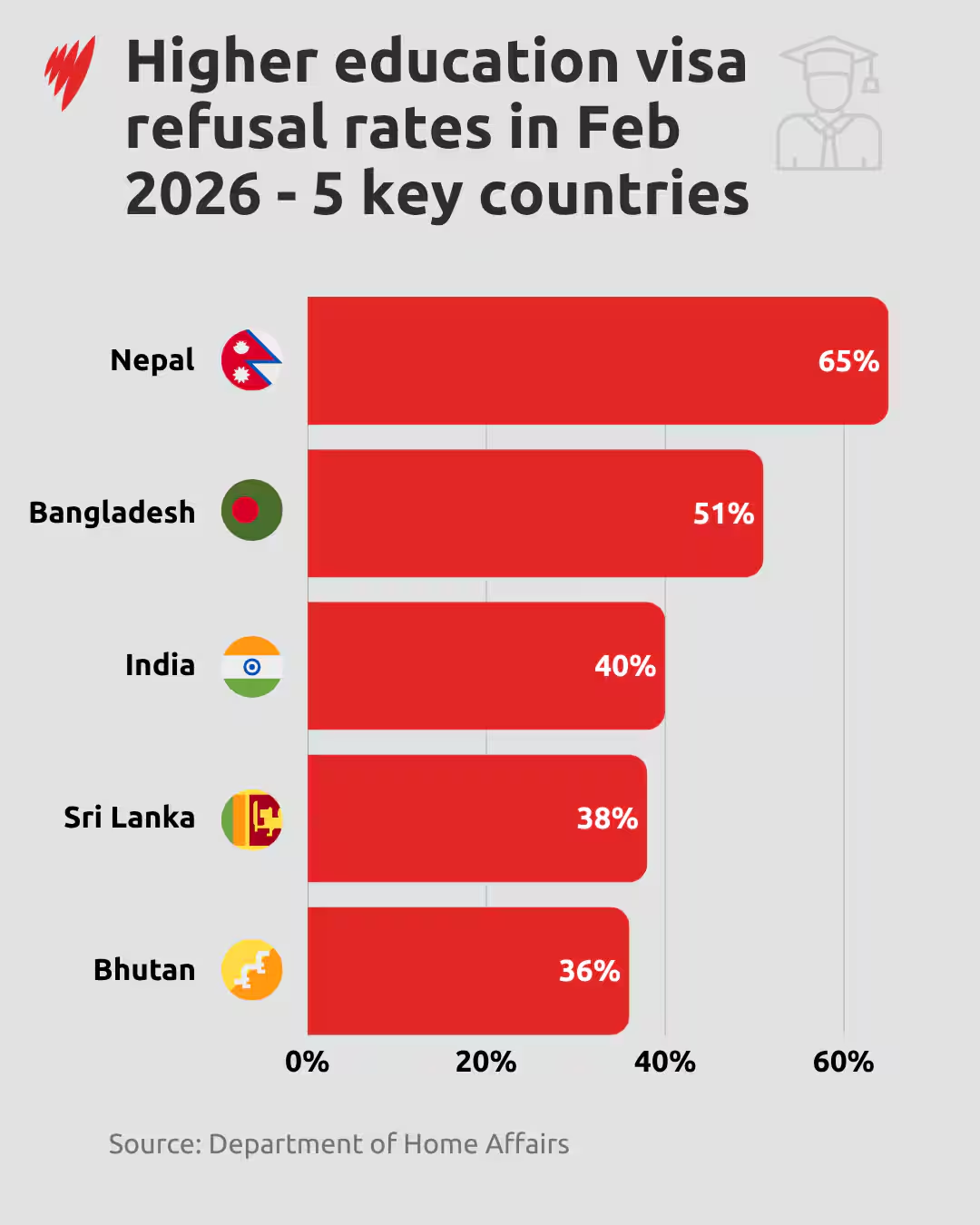
Recent figures show that in February, the department refused 65 per cent of higher education visa applications from Nepal, 51 per cent from Bangladesh, and 40 per cent from India, compared with about 3 per cent from China. However, it is important to note that these countries also account for a significantly higher volume of applications compared to other source nations.
Kailey says the spike in refusals across some of these countries is linked to concerns about document integrity — for example, falsified qualifications, questionable financial statements, fabricated employment histories, and misleading claims about work experience — and argues that a significant proportion of applications are affected by fraudulent practices overseas.
“Unethical practices are carried out overseas to bridge the document gap, leaving the department with no choice but to give blanket refusals,” he says.
Analysis from the peak representative body for 38 of Australia’s universities, Universities Australia, suggests this is not a gradual adjustment but a sharp break from past trends, with current refusal levels exceeding what historical models would predict in key markets.
The Department of Home Affairs frames this shift as a targeted response rather than a blanket tightening.
“Higher refusal rates have been seen following an increased focus on integrity and quality in markets that have shown a very high level of growth,” a department spokesperson told SBS News in a statement.
“The government’s focus is on ensuring the student visa program supports genuine study and skills development, protects students from exploitation, and remains sustainable.”
What is becoming clearer, however, is that the tightening is no longer confined to the visa decision itself. It is filtering through the entire student journey — from recent visa fee hikes for both student and temporary graduate visas to tougher documentation requirements — effectively raising the bar at multiple stages rather than just at the point of entry.
How Australia got here
Australia’s approach to international students has shifted repeatedly over the past two decades, often shaped as much by political rhetoric as by economic goals.
In the early 2000s, the rapid growth of the foreign education sector exposed weaknesses in the system, including concerns around quality and student exploitation. This led to tighter visa settings and a move away from automatic migration-linked pathways.
A more structured reset followed in the early 2010s under the then-Labor government, including the Knight Review, which streamlined visa processing and repositioned international education as a major export industry rather than a default route to permanent residency.
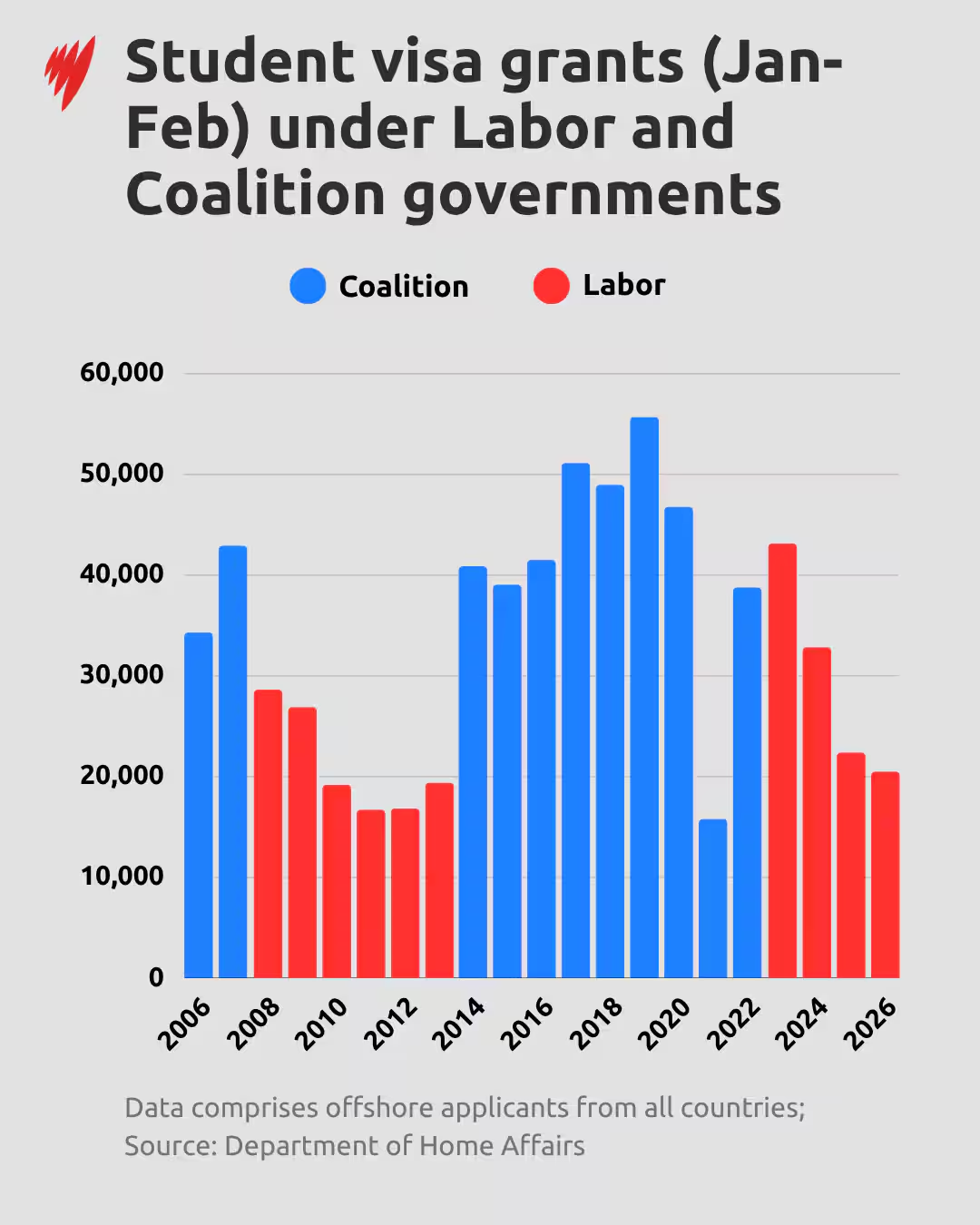
Under successive Coalition governments, settings shifted back towards expansion, with broader post-study work rights and clearer skilled migration pathways strengthening Australia’s appeal as both a study and migration destination through much of the 2010s.
Since borders reopened after the pandemic, international education has again become politically contested. While governments continue to stress the sector’s economic and social value, migration settings have increasingly been shaped by rising anti-immigration sentiment and mounting political pressure over population growth and the housing crisis.
Earlier this month, the Coalition’s migration policy, outlined by Opposition leader Angus Taylor, placed greater emphasis on reducing overall intake, strengthening security vetting, and tightening assessments linked to “Australian values” requirements.
That debate has intensified further in recent weeks. Speaking at a rally on the lawns of Parliament House on Sunday, organised by March for Australia, One Nation leader Pauline Hanson reiterated that migration needed to be done “in a managed way” with “the right people who want to assimilate”.
While Hanson’s previous remarks about international students have been labelled anti-immigration, she has said she is “not against migration at all”, while continuing to call for lower intake levels and tighter controls.
University stakeholders say the political commentary is increasingly being reflected in administrative outcomes. Phil Honeywood, CEO of the International Education Association of Australia, says delays and refusals in student visa processing are fuelling concern.
“With so many student visas now either not being processed in a timely manner or being rejected, there is deep suspicion across the international education sector that the government is responding to the threat from Pauline Hanson’s One Nation anti-international student rhetoric,” he tells SBS News.
Impact on the education sector
Rising visa refusals are beginning to reshape Australia’s international education sector, with universities, private colleges and English language providers feeling the effects in different ways.
Universities Australia CEO Luke Sheehy says this is already affecting institutional planning and capacity.
“Universities are seeing an abnormal spike in student visa refusals, leading to greater uncertainty in their pipelines, which makes it hard to plan, invest and deliver for students,” he tells SBS News.
This not only has an impact on university revenues but the country’s broader economy.
International education remains one of Australia’s largest export earners, contributing around $55 billion annually and supporting roughly 250,000 jobs across education, housing, retail and related services.
Sheehy argues the system now requires greater stability and is “worth protecting and backing”.
“What’s needed is steady, predictable policy and better collaboration with the university sector, so institutions can get on with delivering for students and the nation,” he says.
Outside the sector, Kailey says the pressure is more immediate for smaller providers, where international enrolments make up a larger share of income.
There’s no way they’d be able to survive — the government will have to keep the doors open to international students.
“Even larger universities are affected: how will they pay their professors, fund research projects and cover other core costs?” Kailey says.
Honeywood says the uncertainty is also feeding into workforce planning.
“[Education providers] had geared their 2026 budgets around each of their allocated overseas student enrolment limits for the year. To now discover that they cannot even hope to achieve their government-approved enrolment number will result in more teaching and professional staff job losses.”
Australia in the global context: Canada and the UK
Australia’s tightening approach reflects a broader shift across major English-speaking tertiary study destinations, with Canada and the United Kingdom also restricting foreign student intakes in recent years.
In Canada, caps on international student permits and higher financial requirements have slowed growth, as policymakers seek to manage pressure on housing and services, even as the country continues to position itself as a long-term migration destination.
The UK, meanwhile, has taken a more direct approach to migration reduction, with policy changes aimed at lowering net migration overall. This has included restrictions on student visa dependents (eligible family members) and tighter oversight of education providers, as part of a broader political commitment to reduce overall inflows.
Rizvi says Australia is moving in a similar direction, but not at the same intensity.
“Australia has not tightened as far as Canada or the UK. I would not recommend the government tighten that far, but further tightening will be needed.”
What’s next for Australia’s education sector?
Recent political debate suggests migration reduction will remain a key priority in the upcoming federal budget, with student visa settings continuing to play a central role.
Rizvi says the current direction is unlikely to shift in the near term.
“I expect there will be further immigration policy tightening in the budget. I have been encouraging the government to move to a university entrance exam approach rather than the current highly subjective approach,” he says.
Education analysts expect universities to adapt by diversifying recruitment strategies and reducing reliance on more volatile source markets, as uncertainty becomes a more permanent feature of the system.
Kailey says any near-term changes are likely to be marginal rather than structural, even as political pressure persists.
“Slight changes are expected, in the wake of the ongoing wave that blames migration for every problem — some impact is expected but nothing massive,” he says.
Among applicants, however, the shift is already tangible.
Students like Kumar — who believes he met the student visa requirements, secured admission and still received a refusal — are finding the system no longer operates with the predictability it once did.
His experience underscores the broader shift now underway: a system that is not just tightening, but becoming harder to read, where meeting the criteria may no longer be enough.
For the latest from SBS News, download our app and subscribe to our newsletter.