
Treasurer gives reality check on Anthony Albanese’s hopes for universal child care legacy
The federal treasurer has lowered expectations for major reform to child care in the near future, pointing to affordability as a key consideration.
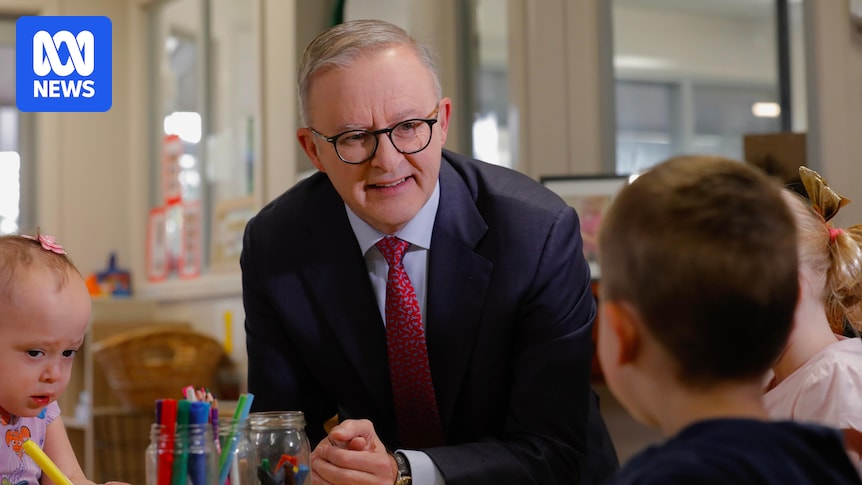
Prime Minister Anthony Albanese has previously declared he wanted universal child care to be his legacy.
But Jim Chalmers has again pointed to cost concerns about Mr Albanese’s passion project.
“From the prime minister right down, there is an appetite to do more in that regard when we can afford to do so,” he said.
“We’re always looking to do more where we can and where we can afford to and as always, we have to calibrate our ambitions to the budget realities that we confront.”

Jim Chalmers is concerned about the cost of delivering universal child care. (ABC News: Adam Kennedy)
The estimated cost of universal child care depends on which model the government would apply.
In 2024, the Productivity Commission, which was asked by the government to look at the concept, did not back the idea.
Its report recommended child care should be cheaper for almost everybody, but not free or at a low flat rate.
“Overall, increasing the CCS rate to a universal 90 per cent or introducing a flat fee for ECEC is likely to disproportionately assist higher-income families who are not, in the main, facing challenges in terms of access to ECEC,” the report said.
Despite the report’s findings, the government has now asked Deloitte to examine the childcare system and to help make further decisions about the pathway toward universal child care.
It is expected to finalise the report and hand it to the government at the end of the year.
Matt Canavan says parents can already access generous childcare subsidies. (ABC News: Matt Roberts)
Nationals Leader Matt Canavan said he did not think it was responsible for the government to extend childcare support to wealthy Australians.
“We already have very generous childcare subsidies,” he said.
“They are accessible for Australians on incomes up to $500,000 a year.
“The idea that we extend universal childcare to people on $1 million a year, I don’t think we have the money for that right now.”
Details light on prime minister’s legacy
Labor has already poured billions of dollars into childcare changes, including increasing subsidy rates, lifting the top household income threshold to $530,000 and removing the activity test to ensure children can access three days of subsidised care.
Mr Albanese first outlined his universal childcare plan in 2020 during his budget reply speech.
“If I’m prime minister, I will make quality, affordable childcare universal too,”
he said.
While not specifying an exact time frame, Mr Albanese flagged it would be a two-term reform.
The expectation had been the policy would be announced before the 2028 election.
The prime minister had previously placed child care high on the agenda. (ABC Newcastle: Ben Clifford)
In February last year, Mr Albanese told parliament he wanted to implement “big, nation-changing reform”, which included universal child care.
“That is something we’re determined to do step by step to make sure that we get it right,” he said
“That is how you build Australia’s future, something that my government is determined to do.”
Following concerns about child safety and allegations of abuse, the government’s focus in recent months has been on the welfare of children, with cost pushed down the priority list.
State and federal governments are working to make the system safer for children, implementing mandatory training for staff and a CCTV trial.
Allegations of abuse at childcare centres were revealed last year. (ABC News: Michael Franchi)
There are also questions around whether a system that has low staff retention rates in some areas and childcare deserts in others could cope with cheaper child care that would boost demand.
However, questions about how and when universal childcare will be introduced have been raised over the weekend, when Mr Albanese conducted several interviews with different media outlets to mark one year since Labor’s landslide victory
He told The Guardian that universal child care was an “important objective to work towards” but would not give a timeline on when it would be introduced when asked by the Australian Financial Review.
“There’s two years to go, we’ll determine our priorities close to the election,” he told the AFR.
The treasurer today said work had already commenced to provide more affordable care, but he did not put a timeline on when the universal element would be finalised.
“It will take time to get to a system which is more universal,” he said.