What is a blue micromoon and when is the best time to see it this weekend? | The moon
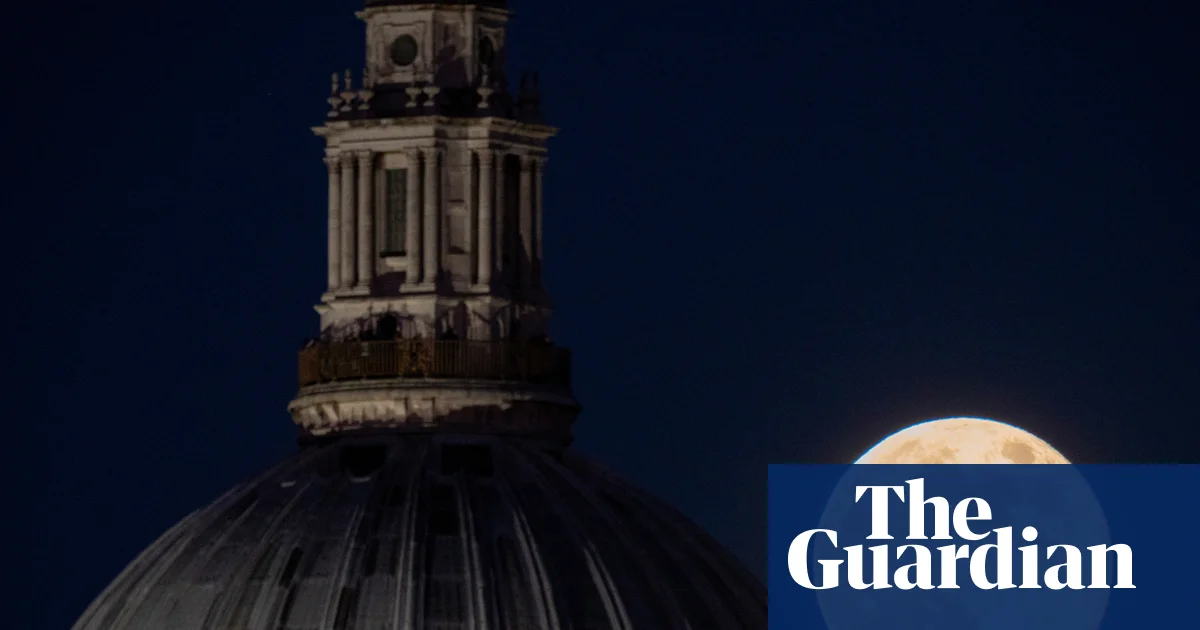
This weekend the night skies will feature a rare spectacle – a blue micromoon. We take a look at what the phrase means and how to catch a glimpse of the event.
What is a blue moon?
There is more than one definition of a blue moon. “Probably the more common one that’s used at the moment, the one that’s better known, and certainly the simplest, is a so-called monthly blue moon,” says Dr Greg Brown, an astronomer at the Royal Observatory Greenwich. “This is where you get a second full moon in one single calendar month.”
That is unusual because the moon takes 29 and a half days to cycle through its different phases – the different shapes we see from Earth – meaning a full moon typically occurs once a month. “But occasionally you’ll get two, and the second one is referred to as a blue moon,” Brown says, noting that this is the type of blue moon occurring this weekend.
A second type is known as a “seasonal blue moon”. In this case, the term refers to an “extra” full moon during an astronomical season – the period of time between a solstice and an equinox, or an equinox and a solstice.
“Within those roughly three months you expect to get three full moons, but occasionally you’ll get four,” says Brown. “And for some reason, it’s the third one which is referred to as the blue moon.”
What is a micromoon?
This refers to the apparent size of the moon as viewed from Earth. “The moon is not always a constant distance away from the Earth. Its orbit around the Earth is elliptical,” notes Brown.
“If a full moon happens to occur close to its closest point, then we call that a supermoon,” he says. “And if it’s close to its furthest point, then we call that a micromoon.”
While the term might suggest the moon will appear as a mere speck in the sky, this is not the case, with Brown noting that a micromoon appears only about 14% smaller than a supermoon and about 6% smaller than a typical full moon.
How rare is a blue micromoon?
Blue moons occur every couple of years, and micromoons occur two or three times every year. The upshot, according to Brown, is that a blue micromoon occurs about once every couple of decades.
However, they aren’t regular and two such events may occur closer together or further apart. What’s more, Brown notes, complexities such as time zone differences – and the international date line – can mean different parts of the world will disagree on whether a full moon is a blue moon.
Using the same definition as for the forthcoming blue micromoon, Brown says the next occurrence for the UK appears to be in 2066 – although some parts of the world, including the US, will have one in 2053.
Is it actually blue?
No – although an unrelated phenomenon can cause the moon to appear blue. As Brown notes, this can occur when there are significant forest fires or volcanic eruptions.
“Then you can get dust in the atmosphere that causes a scattering effect that produces a bluish tinge to the moon,” he says.
What’s the best time to catch a glimpse of the blue micromoon?
The exact time of the full moon on 31 May is 9.45am BST (4.45am Eastern Time in the US; 6.45pm AEST in Australia).
For the UK, that is long after the moon has set. But Brown says: “It will be indistinguishable from being full the entirety of the night beforehand and basically the night after as well.” In other words, for a good view, head out on Saturday or Sunday night.
In the northern hemisphere, Brown says, the moon will be relatively low in the sky throughout the night, while in the southern hemisphere the moon will be very high.
Has this got anything to do with the expression “Once in a blue moon …”?
It is hard to say. “Certainly blue moons are somewhat rare, but once every couple of years is not ridiculous,” says Brown.
Instead, he suggests the phrase could be linked to the rarer blue tint that can occur as a result of smoke or ash in the atmosphere.