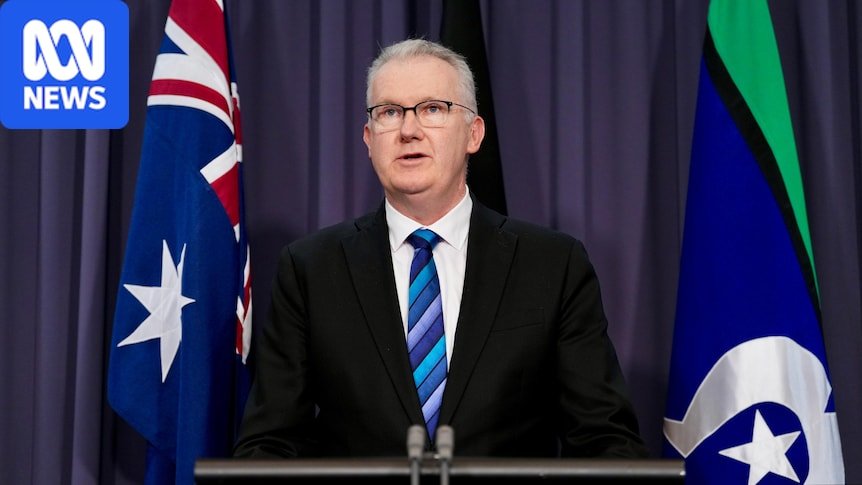
Tony Burke delays National Press Club speech expected to reveal migration cuts
Home Affairs Minister Tony Burke has postponed a speech at the National Press Club, where he was expected to unveil far-reaching changes to Australia’s migration settings in a bid to quell public anger and growing support for One Nation.
Mr Burke was due to appear on Thursday but withdrew on Tuesday afternoon. A government source did not offer a reason for the delay but said the speech would be rescheduled in the near future.
Three sources familiar with the government’s thinking told the ABC the minister had been preparing a package of measures to achieve a quick and drastic cut to net migration. It is understood the proposal was considered by cabinet on Monday.
Among the measures canvassed were tougher family visa rules, a cap on the number of backpackers in the country and restrictions to the work and appeal rights of asylum seekers. Sources said internal deliberations had been highly contentious.
The government has endured sustained criticism from One Nation and the Coalition since a post-pandemic spike in net migration, which exceeded half a million people in 2023. That figure tracks arrivals and departures of both Australians and migrants.

Migration levels into Australia remain above Treasury projections. (ABC News: Billy Cooper)
The spike was caused in part by a glut of demand which had accumulated during the pandemic, when migration was effectively halted, and also because of pandemic-era measures to encourage migrants who were already in Australia to stay for longer.
Before the 2025 federal election, the Albanese government moved to restrict international student numbers. Net overseas migration has fallen to just over 300,000 on the latest figures, but has repeatedly exceeded Treasury projections.
Quiet changes leading up to speech
Last month, Mr Burke quietly made a series of changes likely to further reduce net migration.
They included a substantial across-the-board increase in visa application fees, which was never formally announced but seems to have been decided in the early months of this year, and took effect on July 1.
Budget papers published in May showed the budget would collect an extra $1.2 billion in visa fees this financial year alone, compared to what had been forecast in the December mid-year budget update, and equating to an increase of 24 per cent.

The Coalition and One Nation are pledging to further cut migration if elected. (ABC News)
Mr Burke also made two ministerial directives, ordering officials to prioritise onshore applicants over offshore applicants for permanent skilled and family visas.
There were limited exceptions for those working in law enforcement and defence.
The direction to prioritise one pile of applicants over another is a similar strategy to the one the government deployed to reduce the number of international students.
Given the large backlog of applications, it effectively amounts to a short-term pause for applicants who are de-prioritised, which would in turn reduce the number of overseas arrivals.
Further sweeping changes expected
Mr Burke’s proposed reform package was also expected to prevent the spouses, children and parents of Australian citizens and permanent residents from applying for family visas while they are in the country as tourists.
This has been a common approach for many families seeking to stay together in Australia while they wait for their permanent visas to be approved.
Australian law requires that permanent family visas be granted to all those who apply, provided they meet the criteria. But the number of applicants far exceeds the number of permanent visas the government allocates each year, creating a years-long backlog.
Family members who apply while they are tourists can move onto bridging visas while they wait, retaining the right to work and access Medicare.
If this avenue were removed, they would have to wait overseas until their permanent visas were processed, and may also have their applications de-prioritised under the recent ministerial directive.
Also expected was a restriction on the rights of humanitarian visa applicants to work while their claims were assessed, and to appeal rejections of their claims.
A similar proposal has been floated by the Coalition and One Nation, premised on a longstanding concern that some migrants make false asylum claims so that they can work in Australia while those claims are processed and repeatedly appealed.
Mr Burke was also expected to reveal details of how the government planned to expand the use of lotteries for working holiday-makers, as flagged in the May budget papers.
Lotteries are already used for applicants from China, India and Vietnam, but one source said the government was considering caps on backpackers from all countries who sought to extend their stay into a second or third year.
Currently, eligible backpackers can extend their stay if they complete a regional work placement, although British backpackers no longer have to do this. It is unclear whether the government plans to change that preferential arrangement.
Energy Minister Chris Bowen will address the press club on Wednesday, the day before Mr Burke was scheduled to appear. It is unclear whether the delay relates to internal disagreement over what Mr Burke was planning to announce, but the ABC understands the final content of the speech has not been settled. Prime Minister Anthony Albanese returns from leave on Thursday.
One Nation and the Coalition have both declared their intention to drastically reduce net migration if elected.