
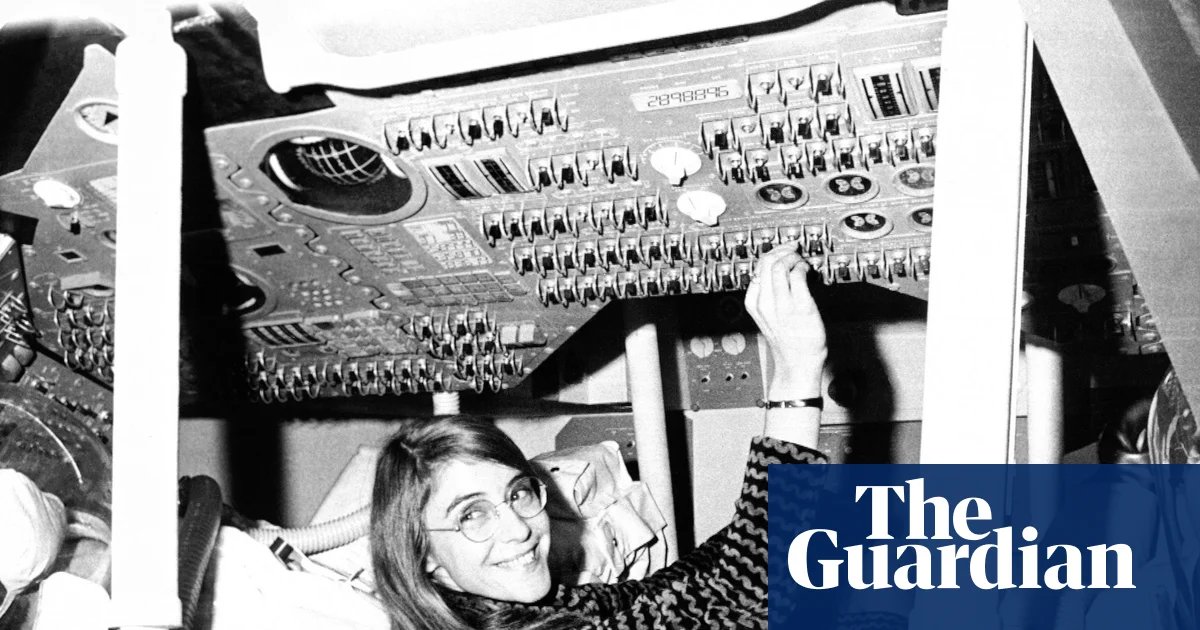
Margaret Hamilton obituary | Space
Apollo was a bold, innovative project. It tested the boundaries of technology and human achievement, and took people to the moon. However, one thing it failed to challenge was the prevailing hierarchy. Nearly everyone involved in Nasa’s space programme in the 1960s was male and white. If you weren’t, you needed to be exceptional at what you did.
Margaret Hamilton, who has died aged 90, was one of those exceptional people. Without her input, sending spacecraft into lunar orbit, and putting Neil Armstrong and his successors on to the surface of the moon, might have been impossible.
Hamilton directed the software engineering division at the Massachusetts Institute of Technology (MIT) Instrumentation Laboratory, which had been charged with developing the computer systems for Apollo. The result of this work was the Apollo Guidance Computer (AGC). This provided the astronauts with a computer-linked keypad, similar in appearance to a calculator and known by the acronym DSKY – short for Display and Keyboard – which they used for navigating and controlling the direction and manoeuvrability of the spacecraft.
In the Gemini missions, which preceded Apollo, astronauts used joysticks to control the spacecraft. AGC removed that necessity, leading to a more precise flight path while freeing the crew for other tasks. It was the first computer in the world based on the silicon-integrated circuits that are now mass-produced and found in everyday electronic devices such as smartphones, televisions and laptops.
One AGC controlled the command module, which remained in orbit around the moon, while a second controlled the lunar module (LM), which descended to the surface. The astronauts could briefly take manual control as the LM approached the landing site, but otherwise AGC flew the two spacecraft automatically.
In July 1969, Apollo 11 became the first mission to put humans on the moon. As its LM, codenamed Eagle, began its descent, alarms went off inside the module. Mission control considered aborting but Hamilton, listening in from MIT, had run the simulations so many times that she realised what had happened: a radar switch had been inadvertently left active. She had seen this during simulations when Armstrong’s companion Buzz Aldrin had made the same error during training, and had previously instructed two of Apollo 11’s mission controllers, Steve Bales and Jack Garman, that unless it happened repeatedly they need not abort. Via the flight controller, Gene Kranz, they reassured Armstrong the alarm could be ignored. Five minutes later Armstrong informed the world: “The Eagle has landed”.
Hamilton told the Times in 2019 that the Eagle’s safe landing was “maybe the most exciting moment of my life,” coupled with the realisation of “the things we’d gone through to get there … everything came rushing through my mind”.
She was born in Paoli, Indiana, the oldest of four children of Esther (nee Partington) and Kenneth Heafield, both teachers. Early in her life, the family moved to Michigan, where Margaret graduated from Hancock high school in 1954, going on to study mathematics at the University of Michigan and then at Earlham College, in Richmond, Indiana. She gained her BA in 1958, the year she married James Hamilton, a fellow student at Earlham. The following year they moved to Boston, where James was to study law at Harvard and where their daughter, Lauren, was born.
Hamilton found work in the meteorology department of MIT, where her first role was developing weather-prediction software, alongside Edward Lorenz, the mathematician and meteorologist and founder of modern chaos theory. Her talent immediately became apparent and she was assigned work on the US air-defence systems before, in 1965, responding to an advert from the Instrumentation Laboratory – also a department of MIT – seeking people to develop software to send humans to the moon.
She was successful, becoming the first programmer for Apollo at MIT, and, of more significance, the first woman working on the project. Within three years she was made assistant director, and soon after became director of the team of about 100.
Unsurprisingly, she was the target of sexism, some which would have led to disciplinary action today – but rarely from her fellow programmers. She told MIT News in 2009: “Dedication and commitment were a given. Mutual respect was across the board. Upper management gave us total freedom and trust. We had to find a way, and we did … There was no choice but to be pioneers.”
As well as her deep knowledge, her insistence on running and rerunning programs searching for glitches was invaluable. One day, Lauren was playing with the command module simulator when she accidentally activated a program called P01 while the simulator was in mid-flight. It crashed the system. Hamilton took note, and when, during the flight of Apollo 8 in 1968, P01 was activated accidentally, her knowledge meant the problem could be fixed mid-mission. Her meticulous approach ensured no software bugs were ever known to have been reported during any crewed Apollo mission.
She also earned herself the epithet “the rope mother” because the core memory for Apollo’s onboard computers was woven from strands of copper interlaced through magnets. These had to be meticulously threaded by hand using professional seamstresses. The work was intricate, precise and double-checked by Hamilton at every stage.
She even coined the term “software engineering”, to draw a distinction between her work and more theoretical computer science, and to explain to non-specialists what her department’s duties entailed.
Once Apollo had been wound down in the early 1970s, Hamilton continued to work at the instrumentation lab. She focused on the Skylab space station and space shuttle programmes, and set up two software companies of her own, Higher Order Software in 1976 and Hamilton Technologies in 1986.
Andrew Meade McGee, curator of computing at the Smithsonian’s National Air and Space Museum in Washington DC, described her as “a seminal figure in the creation of modern, software-driven computing”. He said: “Her practices, drawn directly from working on the AGC, reshaped the computing industry and software education, and still have influence today. Over the years she has inspired many women into STEM careers. Back then, she was often the only woman in the room during Apollo gatherings of systems analysts, but she proved female engineers could excel when given a foot in the door.”
When Hamilton received the presidential medal of freedom from Barack Obama in 2016, he said: “She symbolises that generation of unsung women who helped send humankind into space.” Among many other accolades, she collected the Augusta Ada Lovelace award in 1986 from the Association for Women in Computing, and in 2003 Nasa’s exceptional space act award for scientific and technical contributions. In 2017, a Women of Nasa Lego set was produced, which featured mini figures of Hamilton, the astronauts Sally Ride and Mae Jemison, and the Nasa chief of astronomy Nancy Roman.
Last year Hamilton received the Michael Collins trophy from the Air and Space Museum in Washington, which recognises past and present achievements involving the management or execution of a scientific or technological project related to space exploration. It was collected by her daughter, as Hamilton was too frail to travel.
Her first marriage ended in divorce in 1967 and two years later she married Dan Lickly, an aeronautical engineer, whom she met at MIT. They were divorced in 1973. Thereafter Hamilton lived with Ron Hackler, a former colleague. He died in 2025. Her daughter survives her.