
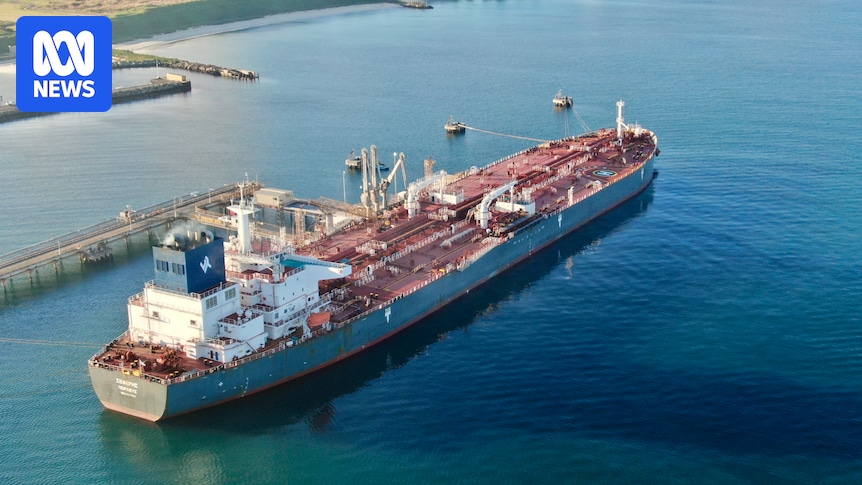
Oil tankers have never stopped, industry assures, though they are in uncharted waters
Ships carrying oil are continuing to come to Australia as expected and should do so for the next month, and the industry is urging that while the picture beyond that is uncertain and complicated, “the tankers have never stopped coming”.
Australia’s fuel companies and industry met on Tuesday where they agreed that the nation’s current fuel crisis was wholly demand-driven, not an issue of supply.
Supplies of crude and refined oil to Australia have been arriving as scheduled since the Middle East war erupted just over a fortnight ago.
NRMA spokesman Peter Khoury says 18 fuel tankers arrived in Australia last week, and another 33 were en route.
Contracted shipments of oil to Australia were all but guaranteed for at least the next month, Energy Minister Chris Bowen said.
“The oil companies say to me that they fully expect all deliveries all through March and well into April, but we are in an internationally uncertain time and that’s why we’re doing such planning at the moment,” Mr Bowen said.
Mr Khoury has urged people to remain calm, saying there has never been a point in Australia’s history when supply wasn’t coming in.
“As long as supply continues there is no need to panic, and supply has been continuing,” Mr Khoury said.
“I know a lot of people are saying, ‘What if?’ so let me put it another way: even in the darkest days of the Second World War, when Darwin was being bombed, Nazi Germany had taken over most of Europe, the war hadn’t turned yet in the Allies’ favour, even then we were still getting supply of oil into Australia.
“The tankers have never stopped coming.”

Peter Khoury says tankers have continued to come to Australia during darker periods of its history. (ABC News: Marcus Stimson)
Global scramble to soften Hormuz blow
Australia receives very little fuel directly from the Middle East, with most coming from Asia, mainly Korea, Singapore, Malaysia, Taiwan and Brunei.
In January just 118.2 ML of oil was imported from the United Arab Emirates, which has been affected by Iran’s blockade of the Strait of Hormuz, compared to more than 5,600 ML of oil from mostly Asian nations.
Nations such as Singapore and Malaysia do import crude oil from Iran and other nations affected by the strait’s closure in order to refine it for export to Australia and elsewhere, and those shortfalls will complicate refining in Asia.
Shipping Australia noted that not only were there fuel stocks in-country, refineries in Asia also had inventory of crude — and just as ships were already en route to Australia with refined oil, ships carrying crude were already en route to Asian nations when the Hormuz Strait was closed.
The peak group said some of the Middle East origin crude destined for refineries in East Asia would only have just arrived or be arriving over the weekend.
Still, there are fears that shortfalls from the crash in oil supply may lead countries to pull back on their exports.
China has banned petrol and diesel exports, and Reuters has reported Mobil Australia is readying for other Asian nations to also curb exports, looking to the United States to cover any shortfalls from Singapore.
Shadow Industry Minister Andrew Hastie said the government needed to spell out its plan for an extended closure of the Strait of Hormuz.
“We really need to get on top of this, they need to guarantee supply of fuel to the economy. There’s no guarantees it ships out past mid-April … they need to be picking up the phone to countries like South Korea, Singapore and Malaysia and guarantee supply from those critical refineries,” Mr Hastie said.
Andrew Hastie urged federal ministers to speak directly with Asian counterparts to ensure stable fuel supply. (ABC News: Matt Roberts)
Mr Bowen said on Tuesday that between himself, Foreign Minister Penny Wong and Prime Minister Anthony Albanese, there was contact with Australia’s Asian trading partners.
Price pains, but there are supply contingencies
About a fifth of the world’s oil, or 20 million barrels a day, previously flowed through the Strait of Hormuz, and another 6 million barrels a day of production in the Middle East has been taken offline, according to Shipping Australia.
Its chief executive Melwyn Noronha said the current outlook remained uncertain, and if the situation continued without change then eventually a shortage would eventuate.
But there are already changes underway.
While a fifth of the world’s oil flows through the Strait of Hormuz, four fifths do not, and oil-producing countries outside the region are ramping up production in order to close some of the supply gap caused by its closure.
Saudi Arabia is also reportedly working to bypass the Hormuz Strait altogether through the East-West pipeline to the Red Sea, which Shipping Australia says could add another 3 million barrels more oil a day.
Those measures won’t close the supply gap from the Gulf states, but it will soften the blow.
French president Emmanuel Macron is also preparing escorts that could reopen Hormuz — though global insurers say high premiums will still limit most tankers from being able to travel.
Attacks to tankers in the Hormuz Strait have made travel prohibitively expensive, as well as dangerous. (Reuters: Mohammed Aty)
Ian Macfarlane, who served as resources minister in the Howard government and non-executive director at Woodside, said price was a problem, but supply was more secure.
“It’s a challenging situation, we are seeing that reflected in prices, but at this stage there is nothing to suggest that supply is going to be turned off,” Mr Macfarlane said.
Loading
Mr Macfarlane said if fuel was sourced from the United States over Singapore it would come from the Gulf of Mexico and have to pass through either a very full Panama Canal or come “the wrong way” past South Africa.
“It will be expensive,” he said.
“All the solutions at the moment until oil supply gets back to over 100 million barrels a day are going to mean more expense to consumers.
“Finding that in other places will be difficult, there will be a lot of competition for it, particularly out of Europe, so we will be looking to our strategic alliances with the US and continuing those relationships that have stood us in good stead for decades and decades.”
Ian Macfarlane says the government is doing all it can to deal with structural issues decades in the making. (Supplied: QRC)
The message, Mr Khoury says, is that the economic threats posed by the Middle East war are serious, and will become more serious if the war continues, but the oil taps are not close to shutting off.
“If the Middle East sneezes the rest of the world catches a cold … there is absolutely no doubt that from a price and supply perspective we all need this war to end, or at the very least find a way to open the strait,” Mr Khoury said.
“The reality is until the war ends we are not going to see any meaningful relief or see the sort of consistent levels of supply.”
There are more basic political forces that could accelerate the return to regular oil trade — like Australia, the United States and Iran are under intense economic pressure caused by the war, the closure of the Hormuz Strait and the rise in global oil prices.
Tipping barrels into a nervous market
Despite supply assurances, retailers have faced massive strain at the bowser caused by a doubling in demand from consumers concerned by the war in Iran and how it might affect distant Australia.
Even though most of Australia’s current supplies of fuel left Asian shores before the outbreak of war, there have been localised shortages prompted by that spike in demand and bottlenecks in supply.
Petrol prices have surged as Australians have rushed to the bowser, fearing higher prices or shortages. (ABC News: John Gunn)
Hoping to calm nerves, Mr Bowen has released six days’ worth of “rainy day” petrol reserves and five days’ worth of diesel to provide fuel companies more flexibility — part of a global measure to tip 400 million barrels of oil into the market over several months to calm traders.
A temporary easing of fuel standards for two months will also add an extra 100 million litres of petrol a month into supply, or about an extra two days’ worth.
That additional fuel is expected to flow through over weeks and months, softening market shocks, not consumed instantly.
Any other releases from Australia’s reserves, currently 37 days for petrol and 30 for diesel, would similarly be expected to augment an ongoing, if disrupted, supply of fuel to the country.
While the government has maintained that it is not yet time for fuel rationing, measures to limit panic buying or ensure priority fuel users have their supply could be considered.
Grattan Institute energy director Tony Wood likened those considerations to buying home insurance — that doesn’t in itself mean the house will burn down.
He said governments already managed gas and electricity shortfalls by requesting big industrial users to temporarily reduce consumption, and that was an option available for fuel.
Mr Macfarlane said the federal government was responding appropriately.
“I think the government is doing everything it can at the moment, this isn’t yesterday’s problem, it wasn’t created yesterday, it was created 30 or 40 years ago,” Mr Macfarlane said.
“I would just re-emphasise to people: don’t fill your car up until you need it, don’t try to store petrol in your shed, it’s highly dangerous and petrol does go off. People have just got to be sensible; we will manage our way through this situation.
“There may be inconveniences but in reality we can get there.“
Mr Khoury said a scenario where tankers stopped arriving to Australia entirely and the nation was forced to rely solely on its reserves had never happened in history and was almost impossible to conceive.
“Looking beyond April, I can’t comprehend what it would take for the tankers to stop arrive completely. It’s never happened before,” he said.
“Please don’t panic, because the tankers are still coming.”
Loading…