
Women’s Asian Cup 2026: After years in the wilderness, North Korea lays down a marker in Western Sydney
On a sticky, overcast afternoon in Parramatta, the North Korean women’s football team returned to the world stage.
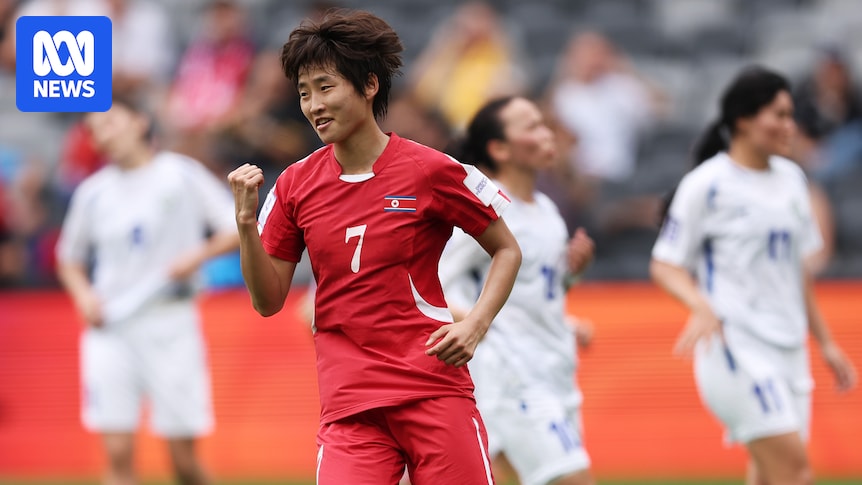
It had been 15 years since the Eastern Azaleas had taken to the field at an international tournament, but they showed few signs of rustiness in their Asian Cup opener, dispatching Uzbekistan 3-0 in front of a smattering of fans, school groups and the odd North Korean flag at Western Sydney Stadium.

North Korea was remarkably slick on its return to the international stage. (Getty Images: Zhizhao Wu)
North Korea is a legitimate superpower of women’s football.
The story goes like this: North Korean delegates watched on at a FIFA congress in 1986 as football’s governing body belatedly promised the women’s game its own World Cup, before returning to Pyongyang enamoured with the idea of becoming a powerhouse of the game.
Since then, the North Korean state has invested into women’s football like nowhere else in the world, providing formal football education in schools, maintaining a far-reaching scouting network, and for the cream of the crop, offering full-time training and development at the Pyongyang International Football School.
North Korea has experienced significant youth team success. (Getty Images: Martín Fonseca/Eurasia Sport Images)
The investment has translated into gargantuan on-field success.
North Korea won three Women’s Asian Cups in the space of a decade in the 2000s, becoming the team to beat in a fiercely competitive continent and edging closer to a maiden World Cup triumph.
However, things well and truly ground to a halt at the 2011 Women’s World Cup, when FIFA accused five North Korean players of using a prohibited steroid.
In response, the North Korean FA provided one of the more memorable doping explanations, claiming that the substance was in fact naturally derived and coming from the glands of a musk deer, only used to help the players recover after their training ground had been struck by lightning.
FIFA didn’t buy it.
DPRK was subsequently banned from the 2014 Asian Cup and 2015 World Cup, before failing to qualify for tournaments in 2018 and 2019, and being forced out of international competition during the COVID years.
However, despite their more than decade-long absence from the world stage, the North Koreans were supremely impressive in the first half in Parramatta.
Playing a fluid 4-4-2, they were almost unimaginably slick through midfield, passing and moving in neat, evolving triangles and hardly allowing their Uzbek opponents a moment on the ball.
Barely three minutes had passed before North Korea had its first Asian Cup goal in almost 16 years, 22-year-old Myong Yu-jong volleying home from just inside the penalty area.
It was a horror start for the hapless Uzbeks, chasing shadows in the Parramatta gloom, and one that was only compounded when goalkeeper Maftuna Jonimqulova went down awkwardly and was stretchered from the field in a neck brace moments later.
It was a bruising encounter for Uzbekistan and a wince-inducing watch for its fans, with Uzbek medical staff called upon at regular intervals throughout the afternoon.
By half-time, Mwong had a hat-trick, courtesy of two well-taken penalty kicks, and it was beginning to look like the 8-0 loss Uzbekistan suffered the last time these sides met in 2023 was a good result for the central Asian side.
Jonimqulova’s tournament may well be over after suffering a nasty neck injury in the first half. (Getty Images: Ayush Kumar)
It was an unquestionably impressive first-half performance from the Eastern Azaleas, and one that did not at all betray their 16-year absence from the international stage.
And perhaps that shouldn’t come as a surprise.
While the senior team has been in the international wilderness, the North Korean junior sides have experienced outrageous success, with the U17 and U20 squads combining for three World Cups since 2024.
The North Korean squad selected for the Asian Cup relies heavily on those world-conquering youth sides, with only three North Koreans at the 2026 tournament over the age of 24, and three players from the victorious U20 side named in the starting XI for match day one.
The game was all but won by half-time. (Getty Images: Zhizhao Wu)
Hat-trick hero Mwong didn’t return for the second period after being inexplicably substituted in the 10th minute of first-half stoppage time, but the game followed a similar path after the break, with North Korea pushing high and aggressively in search of a fourth goal.
However, 49th-ranked Uzbekistan was much more well organised defensively in the second 45, limiting North Korea to few clear-cut opportunities and coming away with what, in the end, was a promising 3-0 defeat, if such a thing can exist.
Surprisingly, it was a rather quiet afternoon for star North Korean striker Kim Kyong-yong, who was substituted on the hour.
She boasts a fairly impressive 26 goals in 18 international games — although five of those strikes came in a 10-0 defeat of Singapore and four in that 8-0 defeat of today’s opponents in 2023.
And 19-year-old striker, Choe Il-son, top scorer at last year’s U20 World Cup, was made to wait for her senior tournament debut, an unused substitute in Western Sydney.
Upon the final whistle, the North Korean celebrations were muted if there at all — it was clear the team was disappointed with its second-half display.
And speaking to the media via a translator after the game, coach Ri Song-ho wasn’t hiding his disappointment in his team’s second half performance, providing a frank appraisal of the six players who entered the game from the bench.
“My main concern was the difference between the starting XI and the substitutes, it was bigger than I expected,” Ri said.
It was a telling indication of the standards expected of this young group of players, tasked with delivering their nation’s long-awaited fourth continental crown.
But while Ri may have been expecting more of his team on match day one, it is clear that North Korea means business at the 2026 Asian Cup.