
How migration debate is reshaping life for Indian Australians
“Too many Indians.”
“Australia is full.”
“Go back home.”
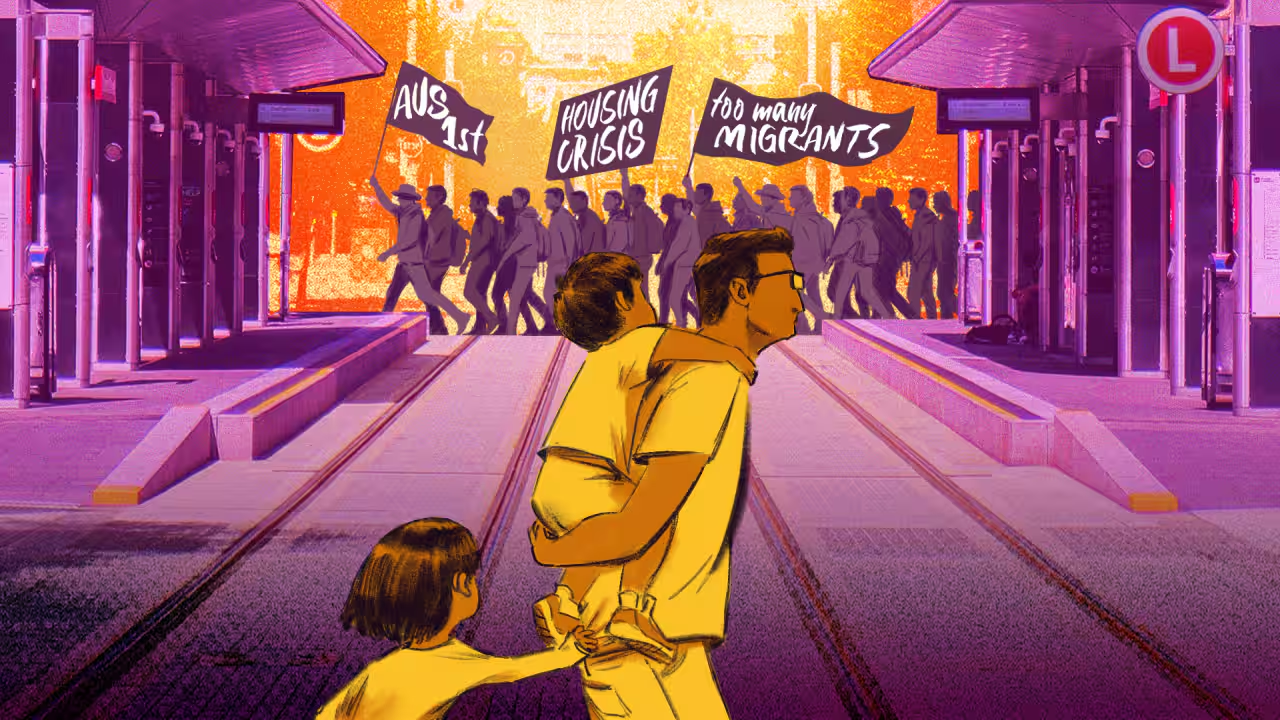
For some Indian Australians, these words are no longer confined to fringe corners of the internet. As migration numbers dominate political and public debate, community leaders say they are increasingly part of daily life — cropping up in social media comment sections, on public transport, in workplaces and neighbourhood conversations.
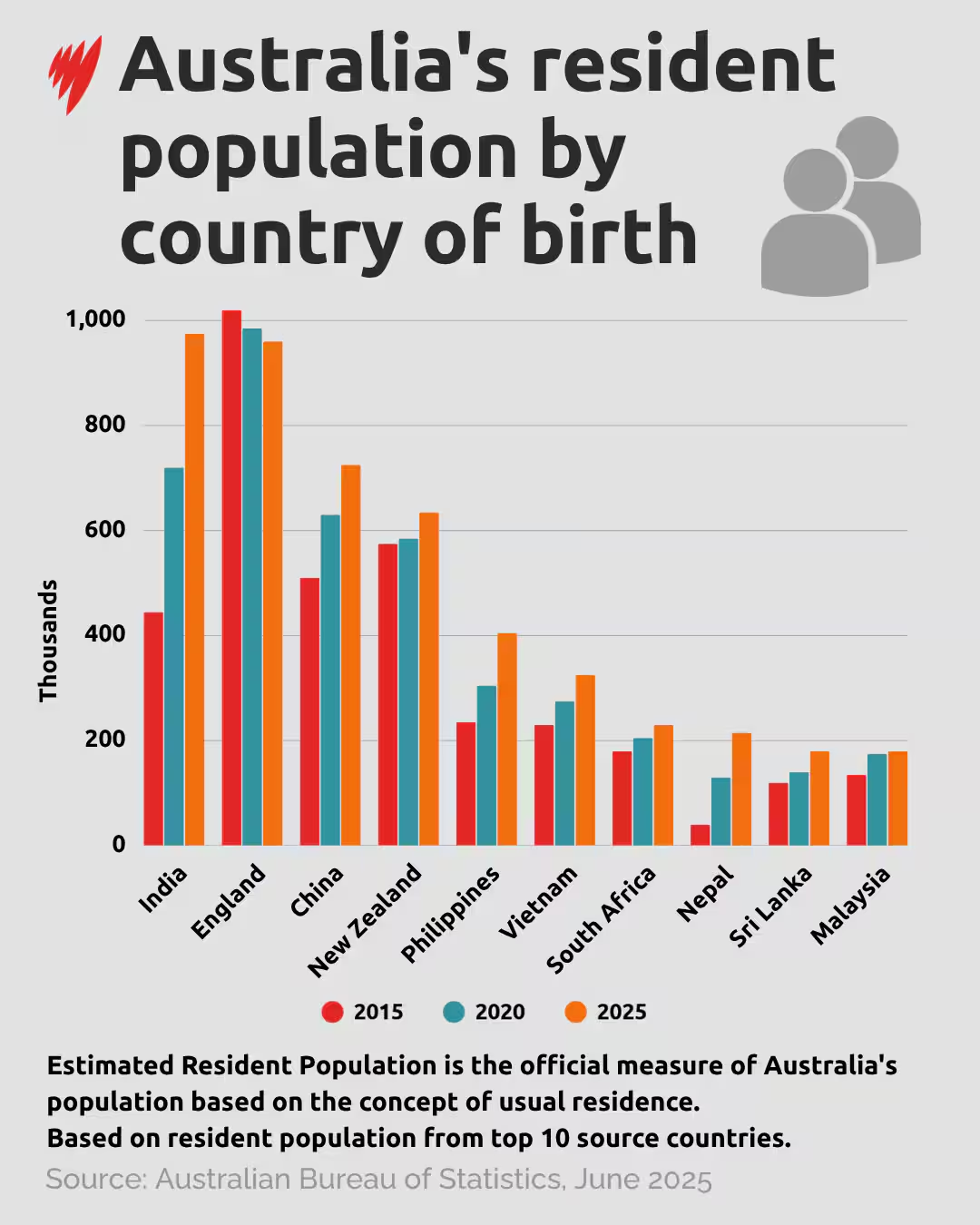
The latest Australian Bureau of Statistics (ABS) data places India at the centre of Australia’s migration story. For the first time on record, people born in India are the largest overseas-born group in the country, narrowly surpassing those born in England in 2025.
Of the 8.83 million Australian residents born overseas, 971,020 were born in India as of 30 June 2025, reflecting steady growth in Indian migration over the past four years.
But behind the headlines and political arguments over migration is a more confronting reality emerging within parts of the Indian Australian community: a growing awareness that migrants are being blamed for pressures linked to housing, infrastructure and the rising cost of living.
Researchers and community advocates say racist abuse and anti-Indian rhetoric have intensified in recent years, amplified online amid increasingly politicised migration debates and public protests.
The concerns echo warnings from Australia’s human rights sector. Last month, Australian Human Rights Commission president Hugh de Kretser warned that rising racism and political polarisation risk undermining social cohesion, particularly when migrant communities are treated as threats or blamed for broader issues.
Launching the commission’s inaugural annual human rights assessment, he pointed to recent anti-migration rallies, saying migrants from India, Muslim communities and people of Lebanese and Palestinian backgrounds had all been targeted in public discourse.
“These attacks on migrants must stop,” de Kretser said in his National Press Club address.
Migration experts say much of the debate often lacks key context, including ongoing domestic labour shortages, post-COVID-19 migration flows and Australia’s economic reliance on skilled migrants and international students.
As India takes on a leading role in Australia’s migration story, the debate is no longer only about population numbers. It has become a test of how Australia balances social cohesion, economic need and multicultural identity amid rising anxiety and political tensions.
Why Indian migration to Australia has surged
India’s rise as Australia’s top source of migrants did not happen overnight.
ABS figures show Indian-born residents have been among the fastest-growing overseas-born groups in Australia in recent years, mainly driven by international education and skilled migration pathways.
Abul Rizvi, former deputy secretary of the immigration department, says the shift reflects broader changes across major source countries. He points to a decline in applications from the United Kingdom following Brexit, alongside reduced long-term student migration from China due to improved domestic opportunities.
Against that backdrop, he says the growth in applications from India is underpinned by the country’s strong economy and a continuing desire among its people to study and work overseas.
“Economic growth in India has meant more people can afford an overseas education,” Rizvi tells SBS News.
“At the same time, job opportunities in Australia are still seen as stronger, although that may change over time as India continues to grow.”
Demographer Liz Allen says India’s position at the top of Australia’s migration intake reflects the profile of younger Indian migrants pursuing education and employment opportunities.
She says public debate around migration has been distorted in the post-COVID-19 period.
“Misrepresentations of net overseas migration (NOM) since the border reopenings have led to the spurious notion that migration is spiralling out of control,” she tells SBS News.
“This is simply not the case. Negative net overseas migration during COVID means Australia has likely not seen the level of growth we would have been on track for had border closures not occurred.”
ABS figures show net overseas migration has eased from its post-pandemic peak, falling from 538,000 in 2022–23 to 429,000 in 2023–24 and down to 306,000 in 2024-25.
Online abuse and rising racial tensions
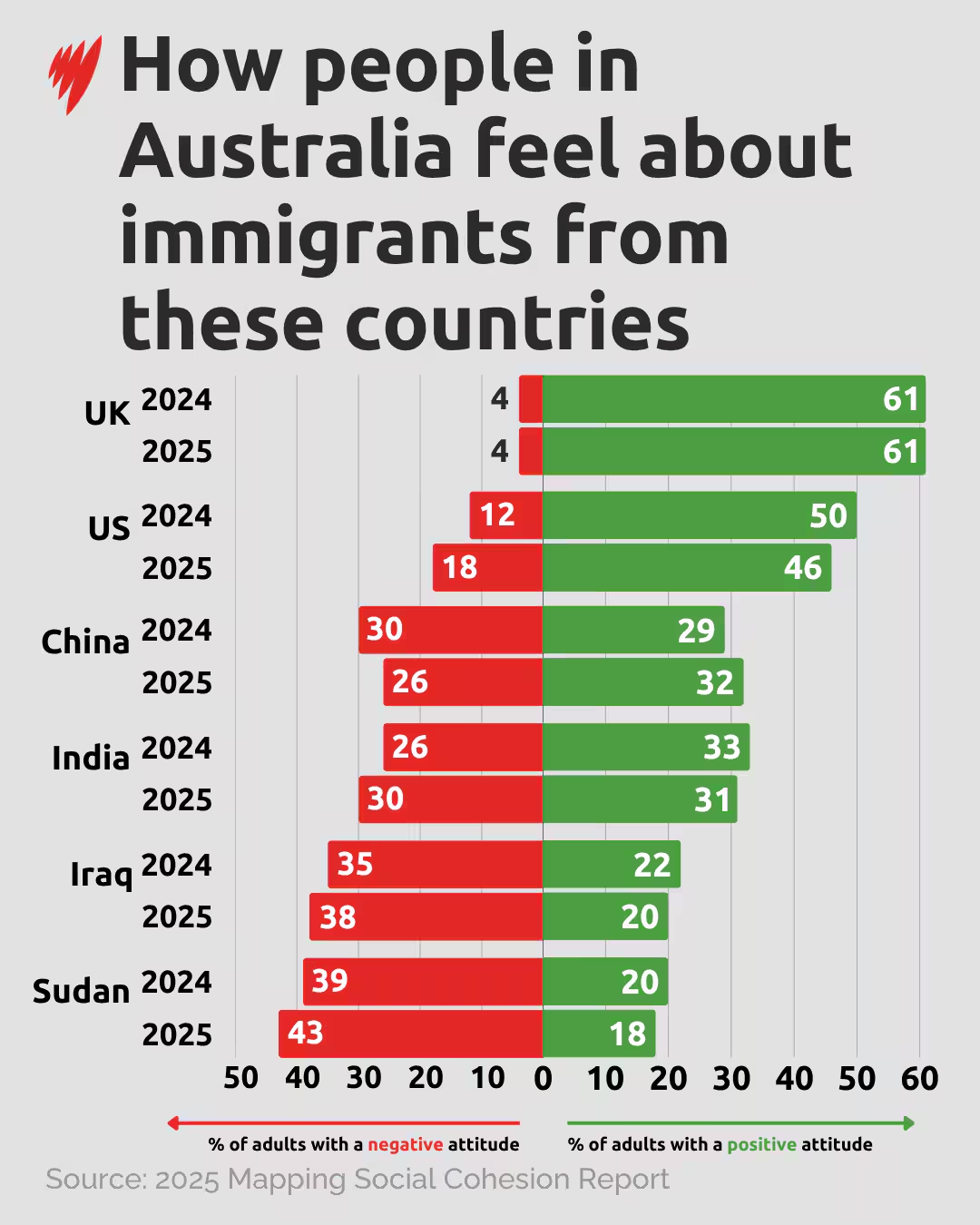
Data from the 2025 Mapping Social Cohesion survey by the Scanlon Foundation Research Institute points to growing unease towards some migrant communities in Australia, alongside persistently high levels of reported discrimination.
The survey found 30 per cent of respondents held a somewhat or very negative view of immigrants from India, compared with 26 per cent for immigrants from China and 43 per cent for immigrants from Sudan.
At the same time, researchers estimated that two in five immigrants from Asian and African backgrounds experienced discrimination in the previous 12 months based on skin colour, ethnic origin or religion.
For some Indian Australians, those figures reflect what they say they are experiencing in daily life.
Amar Singh, a Sydney-based community leader and the founder of Sikh-led food charity Turbans 4 Australia, who arrived from northern India as a student around 15 years ago, says the level of racism towards Indian Australians is the worst he has seen.
Racism towards Indians is at its peak
“In close to three decades here, I have not seen this much blatant racism. This needs to be called out at all levels,” he tells SBS News.

Singh says the current climate echoes the hostility faced by international students during 2008–09, when reports of attacks and discrimination prompted national concern. But he argues the Indian community today is more established and embedded in Australian civic life.
“People who were international students in 2008 or 2009 are now business owners, citizens, voting and fully engaged in the public system,” he says.
James O’Donnell, a demographer at the Australian National University and the lead investigator of the Scanlon Foundation research, says political and public rhetoric could play a significant role in shaping community attitudes towards migrants.
“International research suggests that political rhetoric, particularly when it is divisive and exclusionary, shifts public attitudes and potentially contributes to higher levels of prejudice towards migrant and diverse communities,” he tells SBS News.
“This is still an emerging area of research in Australia, though it appears likely that rhetoric both in public and in online spaces is a mechanism through which national and global sentiments translate to prejudice and discrimination towards Indian Australians and other groups.”
The debate around migration has also sharpened politically in recent years, with phrases such as “mass migration” and warnings that Australia is changing “too quickly” becoming more common amid housing pressures and concerns about strained infrastructure.
The September 2025 controversy surrounding comments by Liberal senator Jacinta Nampijinpa Price, who falsely claimed that Labor was favouring Indian migrants for political reasons — prompted backlash from across the political spectrum and sections of the Indian Australian community, who described the remarks as “divisive”.
The fallout culminated in Price’s removal from then Opposition leader Sussan Ley’s frontbench, after a week-long standoff within the Coalition.
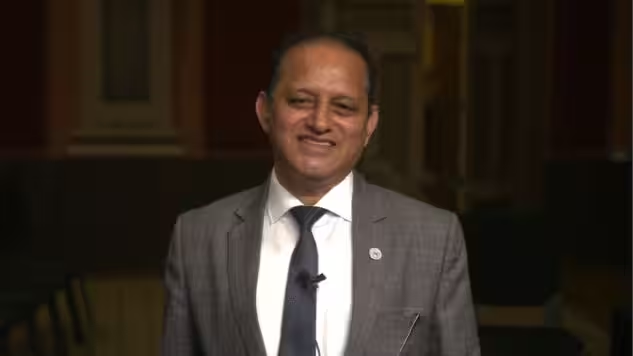
For Vasan Srinivasan, president of the Federation of Indian Associations in Victoria, the present situation reflects a pattern seen across earlier generations of migrants to Australia.
“Greeks went through it, Italians went through it, Vietnamese went through it, Chinese went through it,” he tells SBS News.
“Now it’s our turn.”
Srinivasan, who migrated to Australia from southern India in 1987, says the Indian community’s contribution to Australia is substantial, particularly in skilled professions and essential services.
“Ninety-nine per cent of Indians who come here come with skills. We do contribute every means to put this country forward.”
He says much of the recent hostility has been driven by a small minority, magnified by misinformation and social media commentary.
“It’s not the majority of Australians. It’s a very small section, but they are loud, and that’s what people are seeing.”
He believes the solution lies in engagement rather than confrontation.
“We can manage. We need to educate these people. I’ll tell you once they get to know who we are, they are not going to do what they’re doing. They’re very ignorant at this stage, [a] few of them.”
Is Australia becoming less tolerant?
The social cohesion survey found that concern about migration levels has risen sharply in recent years. In 2022, 24 per cent of adults said the number of immigrants accepted into Australia was “too high”. By 2024, that figure had climbed to 49 per cent, rising again to 51 per cent in 2025.
But researchers caution against interpreting those figures as evidence of widespread hostility towards migrants or multiculturalism.
O’Donnell says many Australians were able to separate concerns about migration levels from their attitudes towards migrants themselves.
“Most people can distinguish their views on migration levels from their attitudes towards people and the contribution of immigration to Australia,” he says.
“Amongst those who said immigration was too high on the 2025 Mapping Social Cohesion survey, most still said multiculturalism has been good for Australia and believe immigrants have benefited Australian society, culture and the economy.”
However, O’Donnell says rising anxiety around migration levels is increasingly being linked to less positive attitudes towards diversity and people from migrant backgrounds.
While anti-migrant sentiment may not reflect majority opinion, he says it can still have damaging consequences for communities, particularly in online spaces.
“It might not be true for all or even most people that spikes in migration contribute to racist and discriminatory attitudes,” he says.
“[But] it could be true for a large enough number of people, though, particularly for the way in which racist attitudes feed off high migration levels in the online space, to have a damaging effect for immigrants and diverse communities.”
The findings suggest that Australia’s migration debate is complexifying: public concern about migration levels is rising, even as support for multiculturalism remains broadly intact.
Migration, belonging and India-Australia relationship
Teesta Prakash, a research fellow in security and geopolitics at the Australia India Institute, says the recent rise in anti-immigration movements in Australia — including rallies such as “March for Australia” — highlights the barriers many Indian Australians still face in achieving full social acceptance.
She argues Australia’s approach to diaspora communities, particularly the Indian diaspora, has not kept pace with the realities of modern multicultural societies.
“Existing studies on the Indian diaspora, while useful for gauging the pulse of the national collective, have largely fixated on outcomes — whether economic or sentiment-focused,” she tells SBS News.
We know that both of these framings of the Indian diaspora — economic asset and surplus actors — fail to tell the accurate story of the sense of belonging of this particular community.

Prakash says this growing visibility has made questions of belonging and representation more central to how the diaspora understands its place in Australia.
Migration has also become central to the broader India–Australia diplomatic relationship, not only because of India’s population size and labour pressures, but because mobility itself has become strategically important to New Delhi.
“India now sees human capital itself as its core economic export and believes trade agreements should facilitate movement of skilled people alongside goods, services and investment.”
The economic case for migration
Australia, like many advanced economies, is an ageing society — a demographic shift that economists and demographers say makes immigration central to sustaining the labour force, productivity and long-term growth.
Allen says Australia is now competing globally for migrants with countries such as the United Kingdom, Canada, the United States and parts of Europe — many of which were once major sources of migration to Australia.
“Demographically younger countries, like those in Australia’s geographic region, have a demographic edge due to their relatively ample working-age populations,” she says.
Alan Gamlen, director of the Australian National University’s Migration Hub, says Indian migrants make a substantial contribution across sectors, including health, education, IT and hospitality.
But as migration has become more visible in public debate, he warns against rhetoric that links migrants to cost of living pressures and housing shortages.
It’s not fair to single out migrants for housing or job pressures.
“These are systemic issues linked to policy settings, market dynamics and broader economic trends — not the result of migration alone,” Gamlen tells SBS News.
The visibility of Indian migrants has often meant the community is drawn into shifts in public sentiment, with tensions resurfacing at different points in time, including the spate of targeted attacks on Indian students in 2008–09 and again in the current cycle of anti-immigration sentiment and migration debate.
“Narratives about Indian migrants often re-emerge because they’re a large, visible group and sometimes become a convenient target during times of social or political tension. This pattern is not unique to Australia.”
Beyond the numbers
For many Indian Australians, the debate around migration has moved well beyond statistics, policy settings and economic contribution. It has become a question of identity and acceptance in everyday life.
“Mate, we are all here because we want to build a future for ourselves,” Amar Singh says.
“Most Indians, if you can talk about just our community, our economic migrants, are here for a betterment of life, for their future generations, and they’re working hard for it.
We are Australians, we’re just Australians of Indian background.
Experts say the challenge for the broader community is to ensure that debate over migration does not harden into division, as the country grapples with balancing economic pressures with the realities of a diverse, multicultural society.
For the latest from SBS News, download our app and subscribe to our newsletter.