
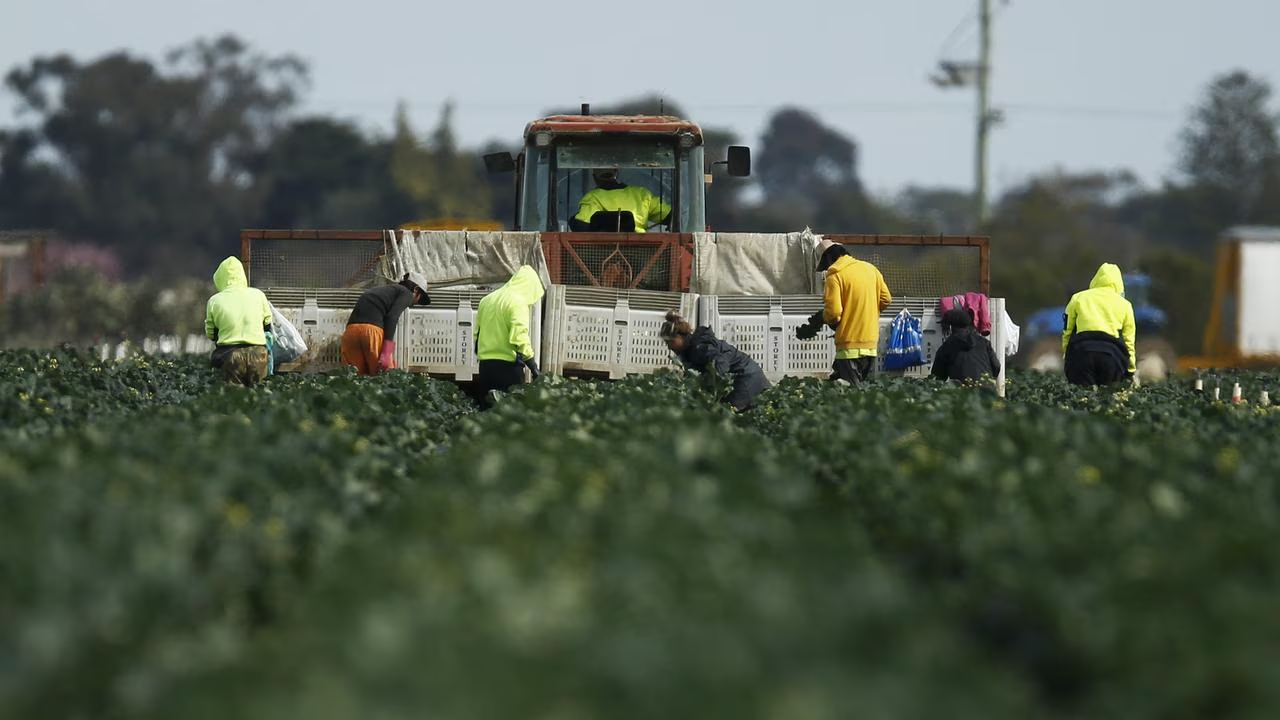
Labor streamlines fertiliser imports as Brunei looks to boost shipments
Labor is moving to streamline import rules for fertiliser as the Albanese governments scrambles to shore up supply in response to Iran war shocks.
With Iranian drones and missiles making the Strait of Hormuz too perilous to transit, 30 per cent of the world’s fertiliser supply has been cut for weeks, spurring warnings of an international “food security timebomb”.
Australia sources some 60 per cent of its urea – the most widely used nitrogen fertiliser – from the Middle East.
Under tweaks to biosecurity rules formally being announced on Thursday, authorised inspectors will be able to declare imports risk-free offshore.
Importers “using higher risk pathways” will need to give a bagged samples prior to biosecurity inspections.
The changes will also include simpler offshore entity registration and easier onshore compliance checks.
“We understand how important fertiliser is for Australian farmers and our food production system,” Agriculture Minister Julie Collins said in a statement.
“We have engaged closely with industry to establish these changes, and appreciate Fertilizer Australia’s commitment to practical collaboration and problem solving.
“The Albanese Labor government will never compromise on biosecurity, but this is a sensible way to streamline the robust systems in place to help get the fertiliser we need faster.”
The changes, made in consultation with Fertilizer Australia, come as Anthony Albanese made the case to Brunei to increase urea imports.
Australia currently sources 11 per cent of its fertiliser-grade urea from the Southeast Asian country.
“Today, at the Brunei Fertilizer Industries, we had the opportunity to talk firsthand about the potential … for an increase in Australia receiving fertiliser in particular from Brunei and we had very positive discussions and that will continue,” the Prime Minister told reporters in the Bruneian capital Bandar Seri Begawan.
“It will continue in the context … of the agreed Joint Statement on Energy and Food Security that was signed by myself and His Majesty.
“This underscores our commitment to ensuring that essential goods continue to flow between our countries.
“And that guarantee … will make a difference as well to provide that certainty by building regional co-operation on energy, security and economic resilience.”
Surprise stopgap
With shortages doubling urea prices since the start of the Iran conflict, farmers have been searching for alternatives ahead of April seeding.
Queensland-based agro-firm MaxSil is among those working to help growers by making their urea stocks go further with a silicon additive.
The company makes its namesake product from recycled glass bottles, converting waste glass into ultrafine silica.
MaxSil works by improving plant uptake of nitrogen, phosphorus and potassium by enhancing root architecture and soil pH balance.
That, in turn, reduces the need for extra fertiliser.
“With fertiliser supply constrained, farmers can’t afford to waste inputs,” MaxSil and agronomist David Archer said.
“MaxSil is designed to make every kilogram of fertiliser count, right now, during the critical seeding window.”
The government has set up a Fertiliser Supply Working Group to find solutions with industry, including jointly engaging with alternative suppliers.
It has also amended legislation to underwrite the fertiliser purchases.