‘In the office of Donald’: Trump in F1 cameo; MotoGP legend backs Italian title drought-breaker
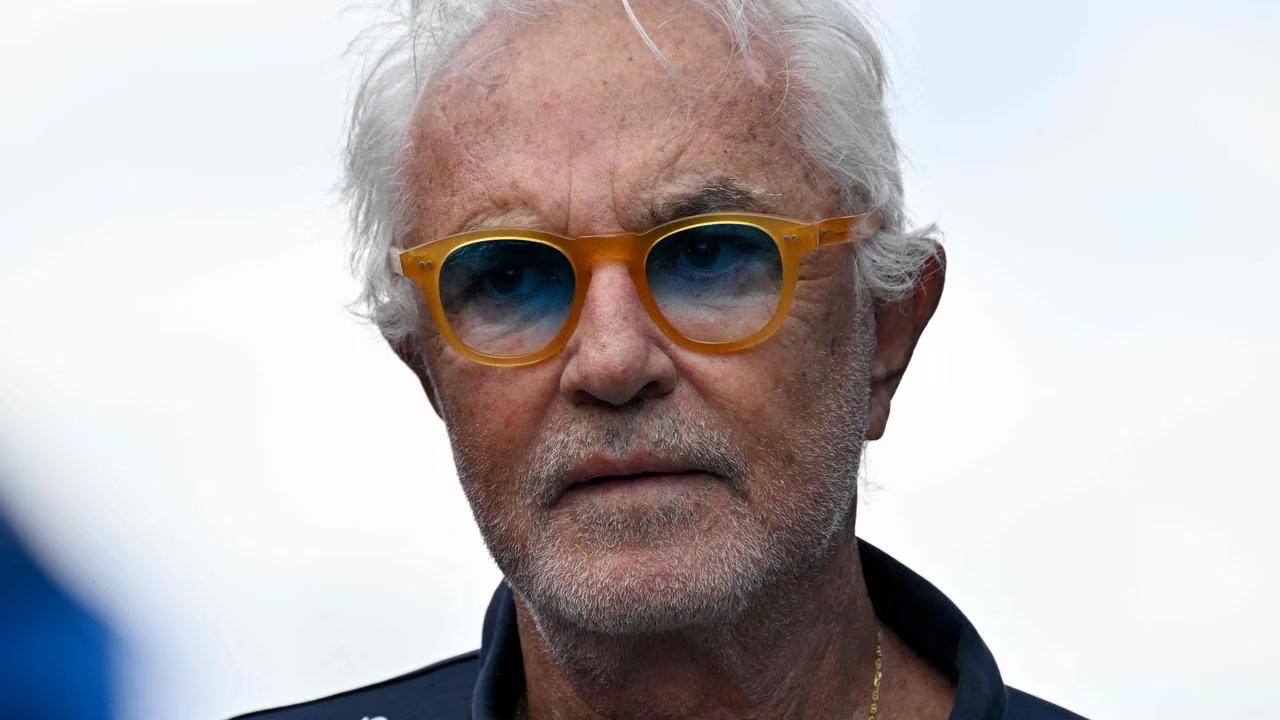
Donald Trump played a significant role in arranging the failed Grand Prix of America in New Jersey, according to Alpine boss Flavio Briatore.
The Grand Prix of America was a proposed street race on the banks of the Hudson River designed to have the iconic Manhattan skyline as its backdrop.
The idea was dreamt up after the collapse of the United States Grand Prix in Indianapolis, which was held for the final time in 2007 after having been mortally wounded by the farcical six-car 2005 race.

Fox Sports, available on Kayo Sports, is the only place to watch every practice, qualifying session and race in the 2026 FIA Formula One World Championship™ LIVE in 4K. New to Kayo? Join now and get your first month for just $1.
Briatore, who was heading the Renault works team at the time, told The Race he and Bernie Eccelstone, the then F1 CEO, pitched the idea of a New York street race to Trump as a potential promoter.
“I tried as well with Donald Trump to have a race in [New] Jersey,” he said.
“Donald had no idea as well about Formula 1, but he’s a great promoter. At the time, he promoted boxing, he promoted everything in Vegas et cetera.
“I made Donald talk with Bernie. I was in the office of Donald. We put in [a] video with Bernie to find what was the best place in New York to do the race.
“Donald [told] us New York is very difficult for a million reasons, but Jersey was the place. So Bernie started negotiating Jersey with two or three different people.”
Briatore and Trump are long-time associates, with the F1 team boss even hosting the Italian version of reality TV show The Apprentice.
After a variety of rejected proposals, local organisers and F1 agreed to a plan for a street circuit in Weehawken and West New York in 2011, and Chris Christie, the then New Jersey governor, announced a 10-year deal for a street race to be held annually from June 2013.
By late 2012, however, the first race was pushed back to 2014 due to a lack of preparedness, but by the following year it was clear the local organisers lacked funding to turn the public roads into a temporary street course.
Ecclestone announced in late 2013 that the contract had been cancelled, and the race was dropped from the official 2014 calendar published by the FIA that December.
With the Circuit of the Americas having successfully held its first United States Grand Prix in 2012, interest from would-be investors in the project faded, as did impetus from Formula 1.
“We did not succeed, because the guy who wanted to build the track went bust — bankruptcy — so it was impossible,” Briatore said.
PIT TALK PODCAST: Did a bizarre backmarker crash cost Oscar Piastri victory in Hungary, and what does Lando Norris’s win mean for McLaren’s season? | Listen to Pit Talk | Watch the podcast on YouTube >
The race was one of a long list of failed Formula 1 projects in the United States, with the sport having struggled for traction and relevance in the country following the demise of United States Grand Prix West in Long Beach, near Los Angeles.
The sport didn’t visit the country at all for most of the 1990s, and though a revival in Indianapolis on paper sounded ideal, it eventually collapsed acrimoniously. Even the race in Austin was on shaky ground financially in its early years.
“We never succeeded because … In America before Liberty [Media] arrived, Formula 1 was not considered something special,” Briatore added. “You talk about … NASCAR, you talk about Indy[Car] — completely different business. When Liberty arrived, everything changed.”
It took Liberty Media’s 2017 purchase of the sport for Formula 1 to take a different approach to establishing itself in the United States, which now boasts three grands prix, with Miami and Las Vegas joining Austin on the calendar.
“Now you go to America, you go to Miami, 500,000 people. You go to Austin, full. You go to Vegas, it’s completely [full].
“You see Formula 1 is changing dramatically. Every race is sold out, raining or not raining.
“What has changed is the commercial side. Liberty is much more open. Bernie was very restrictive with the business. Liberty opened the commercial side — open completely. Marketing [is] open completely.
“Liberty is working with the teams in a very good partnership. This is for the benefit of everybody.”
The race in the United States have among the longest contracts in the sport, with Miami contracted until 2041, Las Vegas locked in until 2037 and Austin signed up until 2034.
Payne overcomes damage to beat Broc | 02:17
ROSSI ‘WITH KIMI NOW’ IN ITALIAN SURGE
Italian motorcycling legend Valentino Rossi is backing compatriot Andrea Kimi Antonelli’s bid to break Italy’s seven-decade championship drought despite the young gun not racing for de facto national team Ferrari.
Despite 85 Italians having started at least one grand in the sport’s 77-year history, only two drivers have won three titles between them: Giuseppe Farina, the first-ever world champion in 1950, and Alberto Ascari, winner in 1952 and 1953.
Before this season, Italian drivers had claimed only 43 victories between them.
Italy’s Formula 1 hopes have therefore typically ridden on Ferrari, Formula 1’s oldest and most successful constructor, with 249 wins and 31 constructors and drivers championships.
But in a meteoric rise in just his second season, Mercedes driver Antonelli has won six times to take a 50-point championship lead into the mid-season break and a 59-point advantage over teammate George Russell.
The 19-year-old’s success is changing the Italian sporting dynamic.
“You can imagine in Italy, with Ferrari, it is like a religion,” seven-time MotoGP champion Valentino Rossi told Sky Sports.
“For sure all the Italians are happy when Ferrari win. But I am more a driver fan.
“I follow Lando [Norris], I follow Lewis [Hamilton], I follow the driver. You know, if you drive for McLaren or for Ferrari, for me it is not a big difference.
“I am with Kimi now. He is a great talent, he has a lot of speed, and in Italy we never had a Formula 1 driver who can win the championship in the last 70 years, so this is very special.”
Speaking at the Belgian Grand Prix last month, Antonelli joked that he still wasn’t the most famous driver in Italy.
“More famous in Italy is Charles [Leclerc],” he laughed. “He’s probably the most famous man in Italy.
“It’s great to see the support when I go back home also because, as Italians, we’re quite emotional. We show our emotions a lot, so to see the excitement is great.
“However, you also need to be careful with the expectations that are built. But it’s always great to be back home, especially after a good weekend, to see so much support.”
Antonelli’s victory in Belgium drew him level with Riccardo Patrese as the second most successful Italian driver in history by race wins. Ascari won the most races for Italy, with 13 victories.
Payne triumphs after Kostecki crash | 01:40
AUDI WON’T UPGRADE ENGINE UNTIL 2027 DESPITE DEFICIT
Audi says it won’t use its second engine upgrade opportunity this season as it focuses on a more significant redesign for 2027.
The German marque was one of four engine builders — that is, every manufacturer except Red Bull Powertrains — to receive development concessions for this year and next season under the sport’s contentious additional development and upgrade opportunities (ADUO) rules.
The FIA judged the brand’s first-attempt F1 engine to be more than 4 per cent down on power to Red Bull’s declared benchmark, entitling it to two upgrades this season and another two next year.
Audi brought its first upgrade almost immediately, to the Barcelona-Catalunya Grand Prix, which targeted driveability.
Driveability has been a particular weakness of the German-made motor, which is believed to have the largest turbocharger on the grid. Big turbos have proved disadvantageous this year thanks to the way the more hybridised engines work.
The larger turbo has cost Audi a cumulative 56 places off the line over all starts this year.
Before the Barcelona upgrade, it was losing an average of three places between both cars across sprints and grands prix. That average has since fallen to just one place per start.
But despite Ferrari reportedly being poised to bring its second of two engine upgrades after the mid-season break, having expected to receive development concessions from early in the season, Audi has revealed it won’t upgrade its engine until next year owing the cost cap on power unit development.
Engine concessions cannot be carried over between seasons, meaning Audi’s second update chance is effectively discarded.
“Everybody has got this trade-off between when you’re bringing upgrades — chassis and [power unit] — and also where you spend your money,” racing director Alan McNish said, per Autosport.
“You can’t spend everything at one time, because then you don’t have anything to fight with later, so it’s got to be a managed expectation and not just over one season but multiple seasons as well.
“Certainly, from our point of view, with the ADUO, we brought something in Barcelona straight away, which was some small adaption, and that worked well, that helped us on our way.
“The bigger parts are for 2027, so we will not see anything big on the power unit until then.”
Audi chief Mattia Binotto has previously claimed that his team has one of the top four chassis on the grid, highlighting the weakness of its first-ever F1 engine.
On average this season Audi has been the seventh-quickest team, 1.442 seconds off the pace.
Those numbers improve to sixth and 1.264 seconds off the pace following the new engine introduced in Barcelona.