
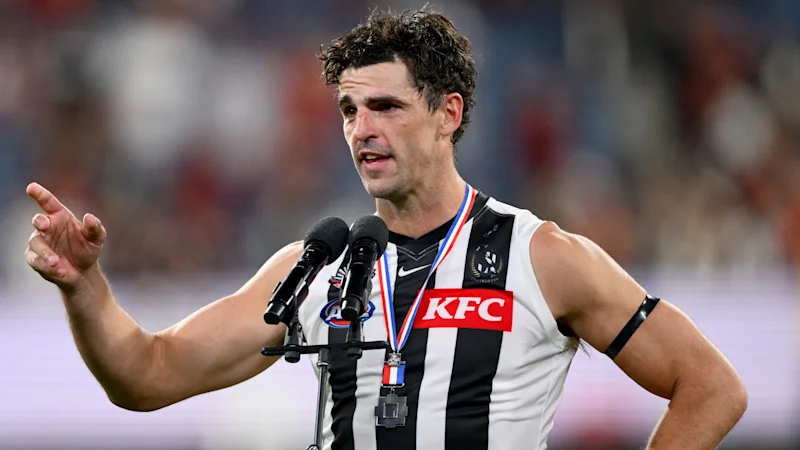
Collingwood analysis: List management and midfield woes exposed in loss to Geelong Cats

When they were belted by Brisbane only weeks ago Collingwood were without their previous captain, current captain and future one: Scott Pendlebury, Darcy Moore and Nick Daicos. That loss could be explained. This one, against the other grand finalist, couldn’t.
There should have been little between the two teams. There wasn’t, it was a gulf.
Partly it was a gulf of their own making in poor goal kicking, an overrun midfield and a defensive breakdown. And partly it was the comparative gap of young talent and list construction.
Collingwood have wanted to emulate Geelong for the way they’ve defied gravity in keeping their list a viable premiership contender. The gap between aspiration and reality was graphically exposed on Saturday night by the team the Magpies want to be.
This looked like a club that played a preliminary final last year clinging to the idea of playing finals, not winning flags.
Collingwood’s results distil to unconvincing reading. They have beaten Carlton (only after a post-siren missed shot for goal that gave them a reprieve) and belted Essendon – two teams entrenched in the bottom three. They beat St Kilda and GWS, both below them on the ladder, and drew with Hawthorn in a game where the stats pointed strongly to them losing.
They have been upended by last year’s premiers Brisbane, lost to Adelaide, unluckily fell short to Fremantle and, this weekend, were smashed by Geelong.
The obvious point out of Saturday night’s game was Oisin Mullin had a good night in dulling Nick Daicos’ influence. Daicos had some say in that with uncharacteristically (across his career not the last three weeks) loose disposal by foot and missing a shot at goal.
Moore went off injured after leading with his head. Pendlebury was serviceable but not dominant. He prompted more debate about how and when he is being used and whether marketing decisions were taking priority over football ones. The criticism that his imminent record-breaking game is overshadowing football decisions is glib.
Pendlebury is 38. You wouldn’t ordinarily schedule him weekly five and six-day breaks with travel. We are assuming that if he takes to the field he plays at the same level each game, but players of his age don’t. Pendlebury’s prelim final calf injury and Paddy Dangerfield’s outstanding prelim final and poor grand final a week later are the evidence of the case against when stating old players can back up weekly, especially on short breaks.
The broader question is why a 38-year-old is still so important to this team. Where are the other players are who are demanding his place?
The Magpies have two generational players in their team, a baton torch handover in the midfield between Pendlebury and Nick Daicos. They have no other young star to shoulder the burden for them.
As opposed to when Pendlebury was drafted, which was admittedly before some of his teammates were born, Collingwood built a team of elite talent young around him. Daisy Thomas, Steele Sidebottom, Travis Cloke, Ben Reid and Nathan Brown were a generation of elite players all drafted in a tight window.
Without wishing to trawl over old ground involving the Pies, unwise list management decisions – almost invariably involving the always risky idea of trading current and or future first round picks – have left them without the sort of generation of young players around Daicos that Pendlebury enjoyed.
The club has said henceforth they want to keep their early draft picks and where possible get in earlier in drafts while using free agency and only trading for players with later picks. This is a belated but correct approach and should right the wrong-headed approach of the club summed up by the “show me players not picks’ comment of their coach Craig McRae.
Essendon have now scored more than Collingwood this year. And on Saturday night Collingwood defended like Essendon.
The Bombers are not the sort of side many teams would seek to emulate.
The defensive system that fell apart on Saturday night has been the aspect of the game that has held the Magpies in contests all year even when they have been unable to kick scores at the other end.
Collingwood’s problems were spread across each phase of play and area of the field but the most troublesome was the midfield. Poor kicking for goal kills you, but not as badly as the opposition outscoring you by four goals from centre clearance. At times Collingwood had their starting midfield set up of the 2023 flag – Darcy Cameron, Pendlebury, Daicos and Jordy De Goey – and were still beaten.
The defence, normally a good structure even if a few individuals struggle with one-on-one defending when the moment requires, was without Moore for the second half. This was a structural problem for them, even if Moore had not been playing especially well. Harry Perryman not being there was an understated absence.
Their forward line had plenty of opportunities from forward 50 entries but wasted any idea of momentum through the poor kicking of many culprits.
All parts of the game turn on conversion. Kick as woefully for goal as Collingwood did – six straight behinds for the third quarter including set shots from easy range, hitting the post and not making the distance from 50 – and you help your opponent exploit your frailties.
Give your opponent so many chances to practice their kick-ins, and they will fine tune it as Geelong did. The freedom Geelong had to move the ball from end to end and score was in such stark contrast to Collingwood’s turgid adventure-less ball movement.
Collingwood still have some very good players and a very good coach, they can and will play better than that, but the two games against the two grand finalists have delivered the most sobering and accurate assessment of where they are at.
Tale of two McKays
They are the brothers that tie Essendon and Carlton in their seasons of discontent. Harry was frustrating for the goals he wasn’t kicking, Ben for the goals he wasn’t stopping.
They are their own people but through their careers both twins have been confidence players.
This round was a tale of two McKay brothers. Ben was dropped and Essendon performed better. One might not have caused the other but the two things occurred. The way Ben had been playing lately easing the pressure on him was probably wise.
The same might have been said of Harry with the growing frustration at everyone and everything Carlton recently. The bigger names carry a heavier burden for performance and that burden appeared to be weighing on Harry who in the vernacular of clubs “couldn’t draw you a football” at the moment. Then Harry came out and painted a lovely one.
In the second half McKay was the most authoritative figure on the ground. It was clearly his best game for the year – most marks in a game (10), most kicks (21), most goals (3). But it wasn’t the stats it was the way he was outplaying and who he was playing on. This was against Brisbane and playing on Harris Andrews and he was dominant.
Ruck tweak needed
Dog it in the ruck at the first bounce, and you set the tone for the team.
Coaches have long implored their rucks that in a combative sport the first contest of the match game emboldened or deflated entire teams. They implored their rucks to jump in strongly.
There is much to recommend the new ruck rule, but it needs to be tweaked.
Presently there is as much incentive to run up and baulk at jumping into the ruck and let the other ruckman sail over the centre line for a free kick – assuming they don’t get a hand to the ball which is often the case – than to jump into the other ruck.
The ruck who chooses not to jump should not be rewarded for not jumping. A ruckman who chooses not to jump should relinquish that right.
The return to jumping ruckman has been a welcome change from the new ruck rule (or the return to and old ruck rule) so the logical extension of that philosophical position on the type of ruck contest you want is to not then reward the ruckman who doesn’t jump. No, you don’t want a ruck just jumping across the line to try and smash the other ruckman, but equally you don’t want to encourage a ruck not to jump.
Top-End talk: How to interpret Lyon-speak
When Ross Lyon says all teams should do “heavy lifting” and play in Darwin, that nine games should be played there what he is really saying, and it is not unreasonable, is why us? Why do we cop Darwin? Why do we have to play Gold Coast at a ground they are yet to lose at in the last nine matches? Why us – after having just had to play back-to-back games in Adelaide?
The AFL is not about to start playing nine games a season in Darwin. Not as they add Tasmania to an already maddeningly conflicted and complicated fixture. But they might start adding more teams to the rotation of who plays in Darwin.
Keep up to date with the best AFL coverage in the country. Sign up for the Real Footy newsletter.
 Michael Gleeson is an award-winning senior sports writer specialising in AFL and athletics.Connect via X or email.