
How Art Auctions Choreographed a $2.5 Billion Comeback
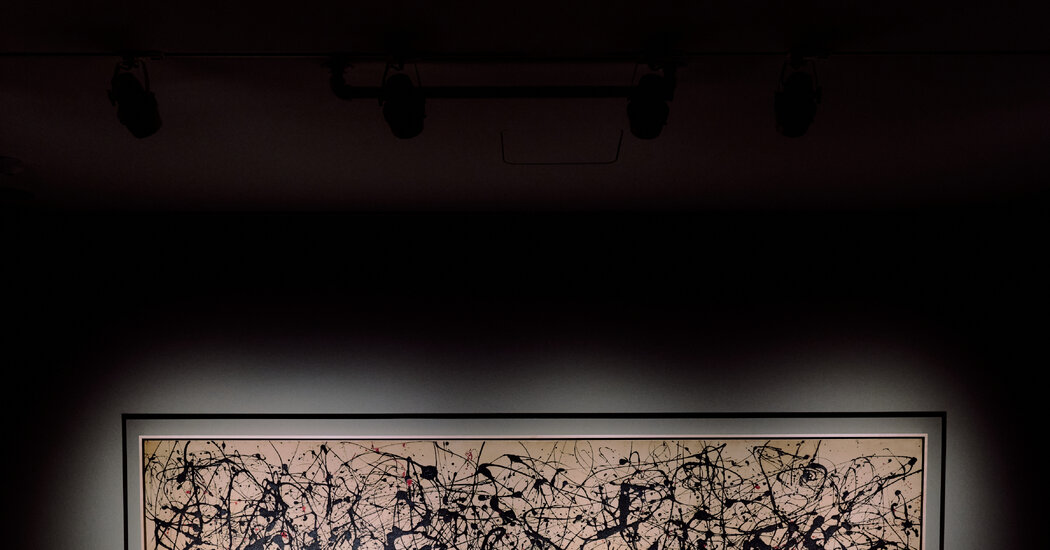
Last Monday evening, as Christie’s prepared to sell a seminal splash-and-drip painting by Jackson Pollock, the executives lifted their phones, covered their mouths and whispered into the receivers. Months of speculation led to this moment, a symbol of the industry’s attempt to reset fortunes after four years of uneven sales.
It worked. Beyond the seven-minute bidding war that cranked the Pollock painting’s value to a record $181.2 million, many artworks across the sales vaulted over their high estimates, with some achieving new auction records. Christie’s, Sotheby’s and Phillips ultimately sold a total of $2.5 billion in artworks, including buyers’ fees, compared to $1.3 billion during the equivalent sales last May.
Auction houses achieved success through a combination of opportune timing and skill. More than $1 billion worth of sales came from the estates of prominent collectors including the longtime leader of Condé Nast, S.I. Newhouse Jr., the art dealer Robert Mnuchin and the philanthropist Agnes Gund. To ensure that high-quality material achieved strong prices, the houses leaned into spectacle — including a promotional video featuring Nicole Kidman dancing around a bronze Brancusi head — and prearranged deals with bidders that reduced their risk.
The result, experts said, was a season with a few flashy records — and, beneath the headlines, a broader return to deliberate bidding, quality material and logical prices.
“The market is healthy but disciplined,” said Bonnie Brennan, chief executive of Christie’s. “We have seen reestablished confidence at the top end.”
Over the last four years, auction executives had blamed weakening art sales on global conflicts, economic instability and a lack of supply of top-flight works. While many of the external challenges remain — including the war in the Middle East — strong results for rare artworks, like the $236.4 million achieved for a Klimt portrait in November, began to restore confidence. The task for this season was to sustain that confidence by avoiding anything that might flop — from works by untested young artists to examples by acknowledged greats with aggressively optimistic price estimates — (recalling the $70 million Giacometti bust that burned Sotheby’s last May).
Auction houses also leaned into the financial engineering behind consignments. In order to win sought-after property, they promised sellers a minimum price. Then they struck deals to offload their own risk to third parties — backers who would either win a particular artwork at what amounted to a discount or, if the bidding went higher, earn a financing fee from the auction house. Either way, these arrangements, known as third-party guarantees, help auction houses ensure success.
Five years ago, experts said, third-party guarantees were off-putting to collectors, who didn’t want to bid against others with insider knowledge. But now it’s become the new normal, especially for works whose prices reach into nosebleed territory. “When you don’t see that, it makes people wonder, why would they bid?” said Caroline Sayan, chief executive of the art advisory Cadell North America. “A lot of clients don’t want to be that first bidder.”
More than half the lots offered in evening sales last week carried third-party guarantees — meaning the auction houses had essentially presold $1.4 billion worth of art before an auctioneer raised a gavel. Works sold to third-party guarantors include Picasso’s $42.6 million “Arlequin (Buste)” from 1909, promoted by Sotheby’s as a Cubist masterwork, and Brancusi’s golden sculpture “Danaïde” (circa 1913), which sold for an auction record of $107.6 million.
And there was more to that Brancusi sale than meets the eye. Because of how Christie’s reports its sales, only the buyer and the auction house know the sculpture’s net price. The buyer, who received a financing fee in exchange for placing a bid in advance, “could have paid a number very far below $107 million,” said Mari-Claudia Jiménez, a former Sotheby’s executive and co-head of art law at Withers Art and Advisory. (Christie’s declined to comment.)
With the spring season in the rearview, here are four other trends from those recent sales.
Art Investment Is a Gambler’s Bet
Even during an auction season that most experts heralded as a success, art remained an unpredictable investment vehicle. An artist might experience record-high sales in one part of the market while seeing steep drop-offs in another. Here are some examples, with historical prices and percentages adjusted for inflation.
An untitled swirling Jackson Pollock painting that sold for $15.3 million ($16.2 million after inflation) in 2024 decreased in value by 46 percent, fetching only $9.2 million at Phillips on May 18. (When the winning bidder in 2024 refused to pay, Phillips — which had guaranteed the work — became its owner until the recent sale.)
An Andy Warhol silk-screen of Elvis Presley that sold for $37 million ($49.1 million after inflation) in 2018 decreased in value by almost 49 percent, selling for $27.1 million last week at Christie’s.
A Willem de Kooning painting that sold for $14.1 million ($20.5 million after inflation) in 2012 decreased in value by 40 percent, selling for $12.3 million at Christie’s.
But elsewhere in the market, prices rose steeply.
A Mark Rothko painting that sold for $6.7 million ($12.1 million after inflation) in 2003 increased in value by 607 percent, fetching $85.8 million at Sotheby’s.
A two-part Formica sculpture by Richard Artschwager sold for $65,200 ($133,200 after inflation) at Sotheby’s in 1998. Its value soared 380 percent, selling for $635,000 at Christie’s.
A Joan Mitchell painting that sold for $1.1 million ($1.6 million after inflation) in 2013 increased in value by 397 percent, selling for $7.8 million at Sotheby’s.
A Gap Widens Between the Ultrawealthy and the Ultra-Ultrawealthy
Experts noted that the auction market can only be as good as the available art. In recent years, what was offered “wasn’t quite trophy level,” said Jiménez. Only one work sold for more than $50 million across the past three spring seasons, compared with six works this time around.
The top performers came from the estates of prominent collectors, including Newhouse and Gund. “We are in a moment of quality-led recovery, largely driven by these single-owner collections and estates,” said Drew Watson, head of art services at Bank of America.
Buyers are not willing to spend top dollar for anything they perceive as substellar. Only about one-third of works priced between $10 million and $40 million outperformed their estimates in the evening sales.
Art priced between $1 million and $10 million fared better, exceeding expectations almost half the time and by a significantly higher margin. At Christie’s on Monday, five bidders chased Alice Neel’s “Mother and Child (Nancy and Olivia),” a 1967 portrait of the artist’s wide-eyed daughter-in-law and squirming first grandchild, to $5.7 million, an auction record for Neel and more than triple its high estimate.
The question remains whether this season’s results are enough to persuade discretionary sellers to consign artworks they’ve been holding onto. “It feels like people have done quite well in businesses other than art, so there’s not been a need for liquidity from art,” said David Schrader, a founder of Pace Di Donna Schrader Galleries.
Dead Artists Soared. Where Did the Living Ones Go?
The speculative buyers who propelled the “ultracontemporary” emerging artists during the pandemic are largely gone, and the auction houses are once again favoring deceased painters from previous eras.
This season’s evening and day auctions offered only 112 works by artists born in or after 1975, down by almost 50 percent compared to a peak in May 2023, according to data by the market intelligence firm ARTDAI.
The evening sale featured just a few new faces like Ding Shilun, who was born in 1998 and lives between London and Guangzhou, and London-born Somaya Critchlow, though Salman Toor and Anna Weyant have appeared in recent auctions.
The offerings suggested the much-publicized shift in taste is, at best, still in transition. The core demographic of auction buyers is “primarily people over the age of 60 and primarily white men. That’s going to continue until those groups reach a point of saturation and stop buying,” Jiménez said.
Selectivity paid off. All 11 works by younger artists in the evening auctions sold over their high estimates, and six set auction records. An ethereal Joseph Yaeger watercolor generated $477,300 at Phillips on May 19, above the artist’s benchmark established just five days earlier at Sotheby’s.
The auction houses also had limited interest in — or space for — diversity. Less than 20 percent of the 239 works lots offered in the evening auctions were by women, per ARTDAI; artists of color were in even shorter supply. But many of the works by both groups sold above their estimates, including a new benchmark for Critchlow.
“Given how much of the evening sales were from single-owner collections — focused on white male artists — women and artists of color were just not a key feature,” said the art adviser Alex Glauber.
American Collectors Crowd Out Asia and the Middle East
Until the first evening sale, on May 14, auction executives were promoting the idea that Middle Eastern collectors were becoming the art market’s new power brokers.
It almost made sense. A Saudi prince acquired the most expensive artwork ever sold at auction (Leonardo’s “Salvator Mundi”) for $450.3 million in 2017. Abu Dhabi’s sovereign wealth fund made a $1 billion investment in Sotheby’s, taking a stake in the company in 2024. And Qatari royals helped stage an edition of the Art Basel fair in the capital city of Doha just last year.
But the region’s collector base is still small, concentrated among the nations’ ruling families. The Arab Gulf states have also become embroiled in the United States’ war with Iran.
“Before they would not even think twice when the work was under half a million,” Samy Ghiyati, a Paris-based art adviser, said of his Gulf clients since the war’s start. “Now they’re considering, do I really need that in my life?”
Philip Hoffman, an adviser with the firm New Perspectives Art Partners, which does business in the region, also noted a new caution among collectors. “They don’t want to sit and talk about art when they have to worry about buying weapons, securing their desalination plants and making sure they can get shipments,” he said.
With the reduction in Russian and Chinese collectors over the last decade, the auction houses have struggled to develop new clientele. This season’s auctions show that power remains concentrated in the United States, whose ultrawealthy patrons took home most of the luxury artworks, according to data provided by the auction houses. Among the exceptions: The Taiwanese pop star Jay Chou was the buyer of Henri Matisse’s light-filled interior scene “La Séance du Matin” from 1924, paying $20 million at Sotheby’s.
“Back when I was in Nice, I used to spend a lot of time standing downstairs outside Henri Matisse’s home, looking up at the balcony by the window,” Chou said on Instagram. “I also used to dream about one day being able to collect one of his works from that period in Nice.”
It’s worth noting that Chou achieved his dream not through heat-of-the-moment bidding, but by guaranteeing in advance to buy the work — and scoring an $800,000 rebate from Sotheby’s in the bargain.