
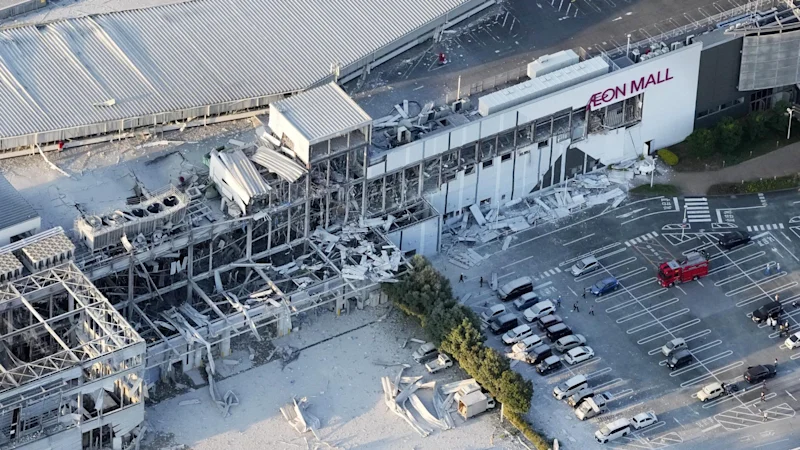
Japan earthquake: Several feared trapped in collapsed shopping mall
Gareth Allan
A major earthquake with an estimated magnitude of 7.1 struck Japan’s southwestern island of Kyushu on Tuesday, injuring at least 50 people and halting transportation in an area that serves as a hub for the country’s semiconductor industry.
The tremor was centred around Kumamoto prefecture, about 900 km (560 miles) from central Tokyo, and hit at an extremely shallow depth of 10 km, according to the Japan Meteorological Agency (JMA).
Prime Minister Sanae Takaichi told media she had received some initial reports of injuries, while public broadcaster NHK reported that at least 50 people had been hurt.
The quake’s maximum seismic intensity was estimated at 7 on a Japanese scale of 7. Shaking of that intensity makes it impossible to stand, according to the JMA. An initial quake just before 4:30pm Japan time was followed by a series of aftershocks in the same region.
One hospital had reported more than 50 injuries, public broadcaster NHK said. Several people on a high-speed train at the time of the quake were also injured, media reported.
Multiple people were trapped inside an Aeon shopping mall rocked by an explosion that occurred after the earthquake, fire services said. Police said, “quite a few” were presumed dead in the incident, broadcaster TBS reported.
An Aeon spokesperson said customers and employees were evacuated right after the initial quake and that the exact cause of the ensuing explosion was unclear.
Kazuya Tsurunaga told TBS he heard the explosion while cleaning up dishes broken by the earthquake inside a pub about 300 metres from the Aeon mall.
“It was a huge impact,” he said. “A large cloud of smoke billowed up, and because the wind happened to be blowing and the wind direction was towards the shop, the area around us was in a state like volcanic ash was falling.”
Rail operator JR Kyushu stopped all its services, while Kumamoto airport’s runway was closed for safety checks, with no time set for re-opening. Power outages were reported at some 7-Eleven stores in Kumamoto, while NTT Docomo experienced disruptions to mobile services.
No irregularities were reported at nuclear power facilities, chief cabinet secretary Minoru Kihara said.
Taiwan Semiconductor Manufacturing said it evacuated staff at its Japan Advanced Semiconductor Manufacturing facility. TSMC, the go-to chipmaker for Nvidia and Apple operates a factory in Kumamoto prefecture, with a second facility under construction.
Sony Group produces image sensors in Kyushu that are used in smartphones, while Tokyo Electron makes chip tools and advanced packaging equipment in the region.
Chip making in particular is highly sensitive to physical shocks or disruptions in power and processes, and minor hiccups can sometimes destroy whole batches of valuable product.
Japan is one of the world’s most earthquake-prone countries, with a tremor occurring at least every five minutes. Located along the “Ring of Fire” of volcanoes and oceanic trenches partly encircling the Pacific Basin, Japan accounts for about 20 per cent of the world’s earthquakes of magnitude 6.0 or more.
A tsunami warning was issued immediately after Tuesday’s quake, but was later lifted.
Kyushu Electric Power said 48,000 homes had lost power as a result of the latest quake, while railway company JR Kyushu said that it had suspended services, including its high-speed bullet trains.
A massive earthquake in Kumamoto 10 years ago killed 275 people and injured a further 2,739, according to an official count, and damaged thousands of buildings including the city’s castle, a top tourist site.
Some portions of the stone walls at the castle also collapsed as a result of Tuesday’s quake, an official at the castle’s office said.