Reserve Bank keeps interest rate at 4.35pc as Australia’s economy slows down

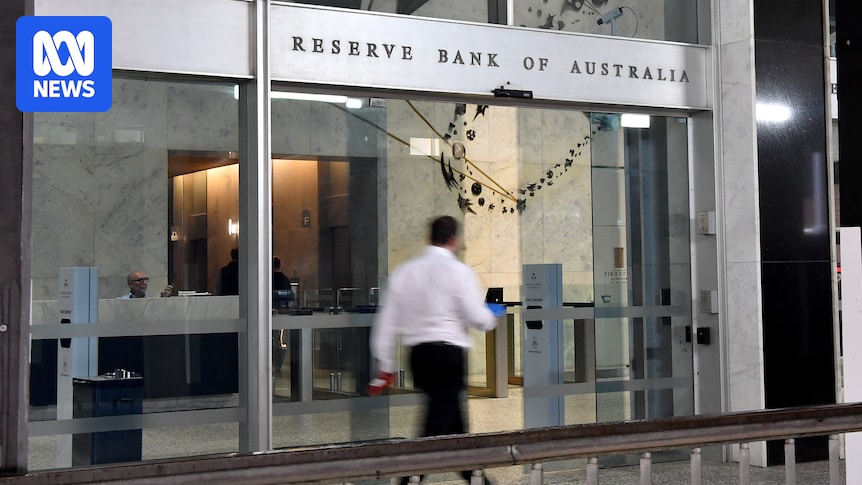
The Reserve Bank has kept interest rates on hold at 4.35 per cent, in a unanimous decision.
The decision comes after recent data showed Australia’s economy has lost momentum and that the unemployment rate has risen.
But with underlying inflation still too high, the RBA has chosen to keep rates steady to see how the economy performs in the coming weeks.
It means the official cash rate will remain at 4.35 per cent for two more months.
The next meeting will be held on August 10-11.
In a statement, RBA board members said the outlook for Australia’s economic activity and inflation was uncertain and that they would keep a close eye on the global economy.
“Following the three increases in the cash rate target since the beginning of the year, financial conditions are now tighter than they were, and there are signs that the economy is slowing as expected,” they said.
“But inflation is still too high and the board judged that it was appropriate to leave the cash rate target unchanged while it assesses the response to previous interest rate rises and the impact of the oil supply disruption.
“Resolution of the conflict in the Middle East is at an early stage, and there are plausible scenarios where inflation is higher and activity lower than envisaged under the May baseline forecasts.”
Has the war in the Middle East really ended?
After officials from the United States and Iran signed an interim ceasefire agreement on Tuesday, which contained a framework for ongoing negotiations, hopes have risen that the conflict could soon end.
But economists say we need to be cautious about celebrating any quick return to pre-war patterns of trade through the Strait of Hormuz.
“Even if it holds, it could take weeks for shipping to meaningfully return through the strait,” Harry Murphy Cruise from Oxford Economics Australia said.
“Undersea mines will need to be identified and cleared before shippers are confident enough to resume normal operations.
“Insurance premiums may also remain prohibitively expensive, while some operators may wait for evidence that other vessels can pass through safely before allowing their own ships to use the waterway.
“As a result, physical flows are likely to recover gradually rather than snap back overnight.
“On top of all that, the inflationary impulse from the nearly four-month oil price shock cannot simply be put back in the bottle,” he said.
Callam Pickering, APAC economist at Indeed, said the RBA faced considerable economic and geopolitical uncertainty, so pausing rates, even if temporary, appeared like the prudent decision.
“The RBA will be in a much better position to assess the impact of the Middle East crisis when they meet in August,” he said.
Economists still split on where interest rates are heading
Given the prevailing level of uncertainty, economists have different views on where interest rates are heading.
Mr Pickering said he did not think the hiking cycle was over, with a possible rate hike occurring in August or November.
Abhijit Surya from Capital Economics thought the RBA would lift rates by another 0.25 percentage point at some point, for a peak cash rate of 4.6 per cent.
But Adam Boyton, ANZ’s head of Australian economics, said the risk of a rate hike in August was not trivial, but rate cuts were the more likely next sequence of rate moves.
“We have pencilled these [cuts] in for the second half of 2027 (August and November) with the RBA likely to proceed down that path cautiously,” he said.
In her post-decision press conference, RBA governor Michele Bullock acknowledged that there was a split among economists at the moment.
“Some are calling for cuts, but not until next year, so it’s not imminent. Some are still thinking that there’s a rate rise [coming],” she said.
“I think there’s a little bit of a difference here … on their interpretations of the data, on how much weight to put on the softness in the economy and how much weight to put on the fact that inflation is still above target.”
However, she said underlying inflation was “pretty much dead-on” where the RBA thought it would be at this point in the cycle.
“[But] I can’t rule out that if inflation doesn’t respond in the way we expect it to do, then we might have to do more,” she said.