Sperm whales’ communication closely parallels human language, study finds | Whales
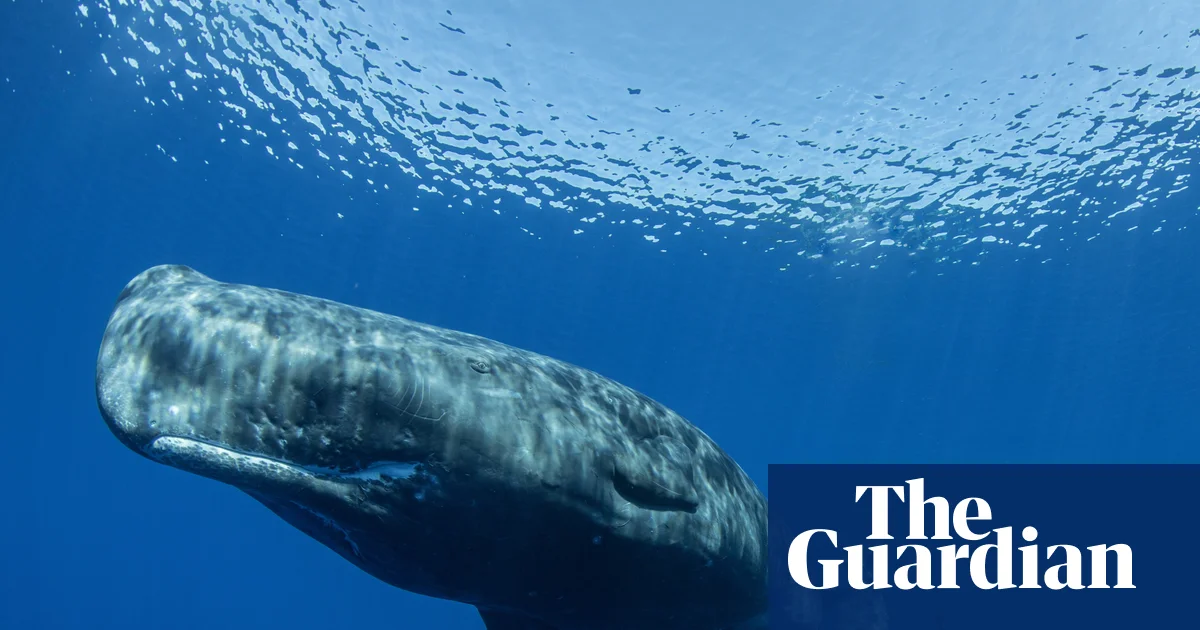
We may appear to have little in common with sperm whales – enormous, ocean-dwelling animals that last shared a common ancestor with humans more than 90 million years ago. But the whales’ vocalized communications are remarkably similar to our own, researchers have discovered.
Not only do sperm whale have a form of “alphabet” and form vowels within their vocalizations but the structure of these vowels behave in the same way as human speech, the new study has found.
Sperm whales communicate in a series of short clicks called codas. Analysis of these clicks shows that the whales can differentiate vowels through the short or elongated clicks or through rising or falling tones, using patterns similar to languages such as Mandarin, Latin and Slovenian.
The structure of the whales’ communication has “close parallels in the phonetics and phonology of human languages, suggesting independent evolution”, the paper, published in the Proceedings B journal, states. Sperm whale coda vocalizations are “highly complex and represent one of the closest parallels to human phonology of any analyzed animal communication system”, it added.
The findings are the latest discovery about the lives of sperm whales by Project Ceti (standing for Cetacean Translation Initiative), an organization that has studied whales off the coast of Dominica in an attempt to find out what they are saying. Last month, the project released video of a sperm whale giving birth while other whales supported it.
Until the 1950s, it was not clear to scientists that sperm whales even vocalized but modern technology, including artificial intelligence, is helping unlock the language of these creatures – with unexpected similarities to our own speech.
“I think it’s another humbling moment that we’re not the only species with rich, communicative, communal and cultural lives,” said David Gruber, founder and president of Project CETI.
“These whales could be passing information along generation to generation to generation for over 20 million years. Humans now are just having the right tools and desire to be able to look at whale voices in this way to see the complexity that has been there all along.”
Studying sperm whales can be challenging – they dive deep underwater in search of squid to eat for as long as 50 minutes, only surfacing for 10 minutes at a time. But it’s near the surface where the animals “chit-chat”, as Gruber put it, with their heads close together.
“If you watch sperm whales, they put their heads right together and click into each other’s heads,” he said. “It’s like if you wanted to talk to someone about a Chaucer novel or something – you wouldn’t want to do that from opposite ends of a football stadium. You would want to get real close to have a real sophisticated conversation.”
That sperm whale conversation sounds, to our ears, little more than a staccato morse code. But by removing the gaps between the clicks, researchers were able to find patterns strikingly similar to human speech. Much like how we alter our vocal folds to change an “A” sound into an “E” sound, whales can manipulate vowel sounds into different meanings.
Gašper Beguš, a linguist at University of California, Berkeley who led the new paper, said that this level of complexity in sperm whale speech was beyond anything he had studied in other creatures, such as parrots and elephants, and highlights the parallels between our lives and those of the whales.
“They have very different lives to us – they’re not stuck to the ground all the time, they float in the water, they sleep vertically,” said Beguš.
“Yet you realize that there’s a lot that unifies us. They have grandmas, they babysit each other’s calves, they give collaborative births, they’re very loud during a birth and so on. It’s such a distant intelligence, but in many ways very relatable.”
The new study shows that “sperm whale communication isn’t just about patterns of clicks – it involves multiple interacting layers of structure,” said Mauricio Cantor, a behavioral ecologist at the Marine Mammal Institute who was not involved in the research. “With this study, we’re starting to see that these signals are organized in ways we didn’t fully appreciate before.”
The latest discovery around sperm whale speech has inched forward the possibility of someday fully understanding the creatures and even communicating with them. Project Ceti has set a goal of being able to comprehend 20 different vocalized expressions, relating to actions such as diving and sleeping, within the next five years.
Actually being able to fully grasp what the whales are saying, or being able to converse with them, is still a longer-term proposition, Gruber said, but not an outlandish one.
“It’s totally within our grasp,” he said. “We’ve already got a lot further than I thought we could. But it will take time, and funding. At the moment we are like a two-year-old, just saying a few words. In a few years’ time, maybe we will be more like a five-year-old.”