Victorian teacher strikes: Term 2 strikes to close Victorian schools through May and June

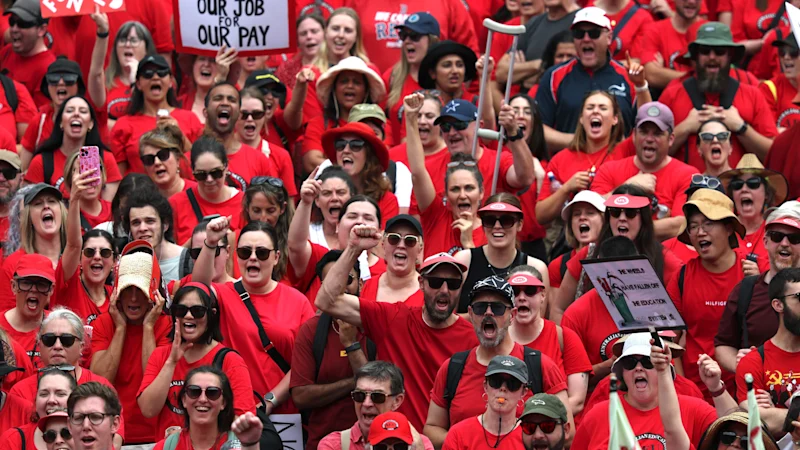
Hundreds of government schools across Victoria will shut for half a day at a time during May and June as educators walk off the job again as part of their fight for a better deal on pay and working conditions.
The rolling strikes will begin on the morning of May 6 – the day after the state government presents its election-year budget – with teachers, principals and support staff across a vast stretch of Melbourne’s west and north-west stretching from Maribyrnong to Sunbury to take industrial action.
Instead of heading for classrooms, educators will converge for a protest at the Niddrie electorate office of Education Minister and Deputy Premier Ben Carroll, who on Monday pleaded for teachers to spare families further disruptions.
The striking teachers are due to return to work in the afternoon, but it is unclear if classes will be offered at affected schools on the days of the strikes.
On May 7, educators on the other side of Melbourne, in the Cranbourne, Berwick and Pakenham area will protest outside the office of Cranbourne Labor MP Pauline Richards. Teachers in another 28 districts across Victoria are preparing to hold similar actions throughout May and June.
Educators will also refuse to write comments on school reports, attend official meetings or respond to emails from the Department of Education as part of the Australian Education Union’s general escalation of its industrial campaign.
Unionised principals and deputy principals will also boycott the annual Government Schools Principal Conference at the end of May.
The protests outside electorate offices – and their timing – aim to heap political pressure on the Allan government ahead of November’s state election. Striking teachers from the Bendigo, Castlemaine, Kyneton and Maryborough area are set to descend on Premier Jacinta Allan’s Bendigo East electorate office on May 12.
While the AEU has announced which areas will commit to half-day strikes, it is unclear when parents will be informed if teachers at their school are participating.
The AEU, which has campaigned for Labor in the past two state elections, has also effectively banned Labor MPs and ministers from appearing at public schools as they campaign for re-election, with union members legally entitled to down tools and protest if a member of the Allan government visits their school.
Despite the March 24 strike, in which schools across Victoria closed and 35,000 education staff protested in Melbourne’s CBD, there is still no sign of a resolution to the pay talks, which have been under way since July.
Victorian teachers say they are the lowest-paid public education workforce in Australia and are seeking a 35 per cent wage increase on a three-year deal. They have rejected the government’s offer of 18 per cent over four years.
The state’s education support workers, whose entry-level annual salaries are under $52,000, have been offered a lower pay deal of 13 per cent in a move that has infuriated the union.
A spokesman for Carroll told this masthead on Monday that negotiations were “accelerating”.
AEU Victorian branch secretary Justin Mullaly said on Monday teachers had been “driven” to escalate their industrial action.
“Victoria’s public school staff are overworked and undervalued, with the average school employee doing 12 hours of unpaid overtime a week and experienced teachers set to earn over $15,000 less than their NSW counterparts by October,” Mullaly said. He said that was a similar story for support staff and school leaders.
“These are the dedicated professionals whose work helps to shape the course of children and young people’s lives, but Premier Jacinta Allan and Education Minister Ben Carroll are taking them for granted,” Mullaly said.
“If they care about public school students and families, and want to properly address chronic staffing shortages, they need to immediately fully fund public schools and offer public school staff pay increases that properly reflect the value of their work.”
Rank and file teachers are digging in for a long dispute, according to union sources not authorised to speak publicly. They said the fuel price crisis had hardened the resolve among educators to hold out for a better pay deal.
A spokesperson for Carroll asked teachers to stay in their classrooms and not heap any further disruption to families. He said the government recognised teachers and school staff “have always deserved a pay rise”.
“The significant offer we put to unions reflects the important work our educators do every day. Negotiations have accelerated, the department and AEU are meeting more frequently and we continue to negotiate in good faith,” the spokesman said.
“We urge unions to keep students in the classroom and not disrupt families when considering further industrial action.”
On Monday, one of Melbourne’s most prestigious private schools also launched industrial action after reaching a stalemate with school management over talks for a new enterprise bargaining agreement.
Talks over pay at Lauriston Girls’ School, which charges families $50,752 for year 12 students, have been under way since May last year, and teachers are pushing for an 18 per cent pay rise over three years.
Start the day with a summary of the day’s most important and interesting stories, analysis and insights. Sign up for our Morning Edition newsletter.